
Disclaimer: The medical information contained in this article is for general reference only and should not be regarded as medical advice. If you experience symptoms such as fever, bleeding, dizziness, chest discomfort, shortness of breath, decrease in consciousness, or any other emergency medical situations, please seek immediate medical attention from the nearest healthcare facility.
Medical disclaimer: This article provides general information only and is not a diagnosis or individual fitness-to-fly recommendation. Whether a patient may fly and which medical devices may be used must be assessed by the treating doctor, escort team and airline.
When a family member needs treatment in another city or country but is too frail or has limited mobility, the family may immediately think of an air ambulance. In practice, however, some patients can travel in the business class cabin of a commercial aircraft with a professional medical escort, provided their condition has been assessed and the airline has approved the arrangements.
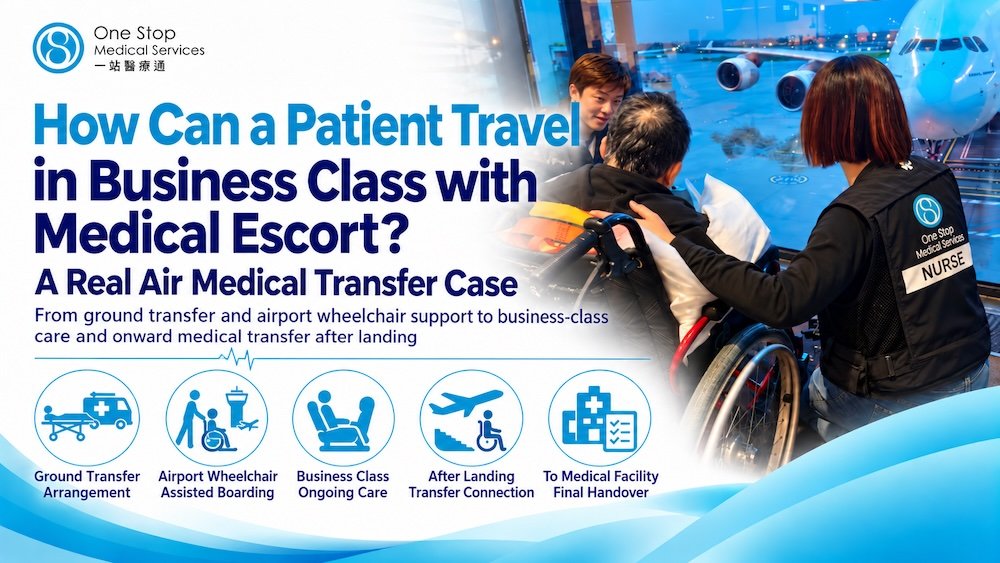
During one of our air medical escort assignments, the patient travelled from an initial ground transfer through airport wheelchair assistance and boarding to a commercial flight, followed by another vehicle transfer on arrival. For someone requiring care, each apparently routine stage involves details that must be coordinated beforehand.
1. Medical escort arrangements begin before the airport
This journey started with a stretcher and ground vehicle transport. Our team assisted with the patient's transfers and the support required along the way. Arranging an air medical escort involves far more than buying a flight ticket: the time the patient leaves the original medical facility, transport to the airport, accompanying personnel and handover of equipment all form part of the transfer plan.
For someone needing continuing care, the team generally has to understand their medical condition, mobility, medication and other support needs in advance. If in-flight medical equipment or oxygen is required, the airline's carriage requirements must also be checked.
2. From ground vehicle to airport wheelchair: transfers matter
In this case, the patient used a wheelchair after arriving at the airport, with assistance through the pre-boarding procedures. While most travellers simply make their way to the gate, a patient may need transfers between a vehicle, a stretcher, an airport wheelchair and the aircraft seat.
We allow additional time for these journeys. As a practical arrangement, we often aim to reach the check-in counter about three hours early, allowing for documentation checks, security screening, wheelchair handovers and any further assessment requested by the airline. Actual reporting times remain subject to the airport's and airline's instructions.
3. Care continues inside the aircraft
Once in the cabin, the patient can sit or recline in the assigned seat, with monitoring equipment arranged as necessary under the care plan. Certain long-haul business class cabins offer lie-flat seats, which may allow medically suitable passengers to rest. Whether a seat reclines fully, and which sitting position is required during take-off and landing, depends on the aircraft configuration and crew instructions.
After boarding, we continue to observe vital signs according to each patient's individual needs. Where the cabin environment and aviation safety rules permit, care may also include help with repositioning, food and drink, or other essential nursing tasks. Care plans differ: the need for intravenous fluids, oxygen or other equipment must be assessed by the medical team and receive any necessary approvals.
4. After landing, there is still another transfer
At the destination, the patient used a wheelchair again, with assistance to disembark and continue by vehicle to a medical facility. Even after a successful landing, help may still be needed with airport formalities and coordination with the receiving ground transport team.
The overall plan therefore has to include not only flight times, but also the onward journey, reception arrangements at the medical facility and any nursing needs during handover.
5. Business class is not suitable for every patient
A lie-flat business class seat is not a medical bed, and a commercial aircraft is not a dedicated medical transport vehicle. A different transfer option may be needed if a patient requires intensive life support, has a substantial risk of acute deterioration, cannot meet cabin safety requirements, or has another condition that makes flying unsuitable.
Whether commercial business class travel is appropriate must be assessed in light of the patient's circumstances by the treating doctor, escort medical team and airline.
Our air medical escort service: connecting the entire journey
An air medical escort involves ground transport, airport assistance, in-flight care and onward transfer after landing. We place particular emphasis on coordination across these stages. Early access to the patient's medical information and intended itinerary helps our team evaluate suitable transport options and preparations.
If you need to arrange a flight back to Hong Kong, cross-border medical travel or transfer to another destination for treatment, contact ONE STOP MEDICAL SERVICES to discuss air medical escort and ground transport arrangements.
ONE STOP MEDICAL SERVICES provides professional point-to-point, seamless medical escort services. We can assist you or your family with complicated procedures and ensure that the patient receives appropriate medical monitoring and care throughout the journey back to Hong Kong.
For a free enquiry, please call or WhatsApp +852 9788 9115.