
Disclaimer: The medical information contained in this article is for general reference only and should not be regarded as medical advice. If you experience symptoms such as fever, bleeding, dizziness, chest discomfort, shortness of breath, decrease in consciousness, or any other emergency medical situations, please seek immediate medical attention from the nearest healthcare facility.
Medical disclaimer: This article provides general information only and is not a diagnosis or individual fitness-to-fly recommendation. Whether a patient may fly and which medical devices may be used must be assessed by the treating doctor, escort team and airline.
For most travellers, choosing a flight, booking a ticket and preparing travel documents are the main steps. For someone recently hospitalised, severely mobility-impaired or requiring medical assistance on board, another step may be necessary: applying for the airline's Medical Clearance.
This is more than paperwork. It enables the airline to understand the passenger's condition, equipment and assistance needs, and to assess whether the journey can safely take place on a commercial aircraft.
1. What are Medical Clearance and MEDA?
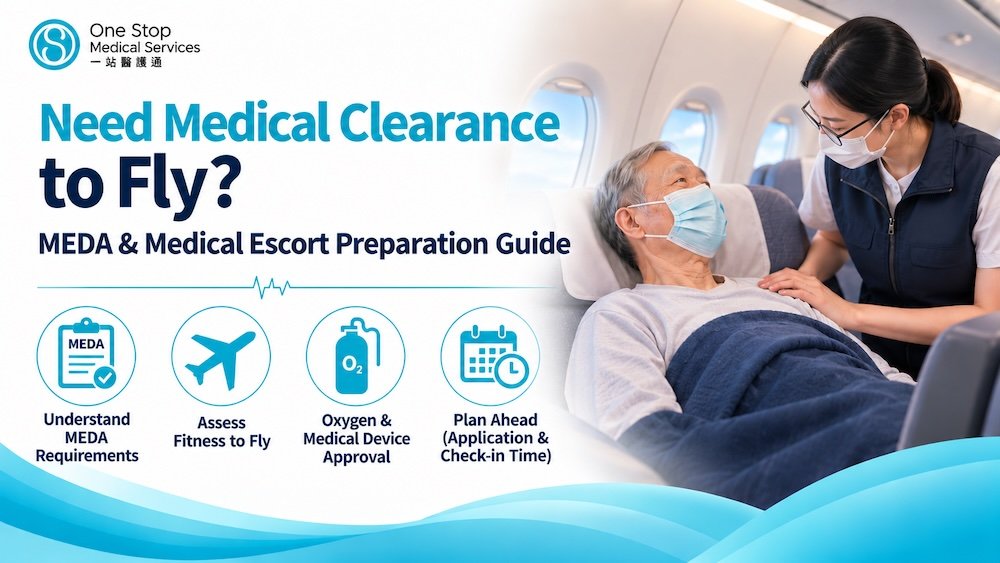
Medical Clearance is an airline's assessment of whether a passenger with particular medical needs is suitable to fly. MEDA is the medical information form used by some airlines to support that assessment.
For example, Cathay Pacific may require a MEDA form when a passenger has recently been ill, injured, operated on or hospitalised, or when an existing health condition raises questions about safe travel. Passengers who require supplemental in-flight oxygen, certain medical devices or stretcher transport may also need approval.
The passenger or representative generally provides personal and itinerary details, while the treating doctor completes the medical section for airline review. Not every passenger who uses a wheelchair automatically needs MEDA; the airline's case-specific requirements should be confirmed.
2. Why not leave the application until departure day?
The airline needs time to review documentation, check the requested medical support and confirm whether the proposed arrangements can be provided on the flight. According to Cathay Pacific's stated application requirements, a completed MEDA form is generally required at least 48 hours before scheduled departure when the process applies. Requests for the airline's medical oxygen are recommended at least 72 hours before departure.
These are the requirements of a particular airline and do not mean every application will be approved within 48 to 72 hours. Missing paperwork, changes in condition, connecting flights or other special arrangements may require more time.
Families should therefore check requirements with the treating doctor and airline before purchasing non-refundable tickets wherever possible.
3. Information the medical escort team checks before departure
The medical team generally needs to understand the diagnosis and recent condition, vital signs and medication, ability to move and transfer, oxygen and equipment needs, and whether feeding, repositioning or other care will be required. Flight details are equally important: aircraft type, seat configuration, airport wheelchair assistance, connection times and receiving ground transport.
Where a portable oxygen concentrator, monitoring device or other electronic medical equipment is needed, the model, battery capacity and usage restrictions may also need confirmation. The airline may ask for additional documentation and retains the right to decide whether to carry the passenger.
4. Why do we arrive at the airport early?
For medical escort journeys, we generally allow extra check-in time. Reaching the counter around three hours before departure may help accommodate security screening, wheelchair handovers or any further checks the airline makes on the patient's condition, reducing pressure immediately before boarding.
Even where approvals have been completed in advance, the airport may still need to verify identity, pre-booked assistance and the passenger's actual boarding arrangements. Early arrival is a practical risk-management measure; the specific timing must follow flight and airport instructions.
5. Frequently asked questions
Does a doctor's note guarantee boarding?
No. The treating doctor's report is important, but the airline makes the final decision under its carriage and safety rules.
Does every passenger accompanied by a medical professional need MEDA?
Not necessarily. It depends on the medical condition, assistance required and airline rules. Families should not assume that the application is unnecessary.
If medical oxygen is approved, may I use my own oxygen cylinder on board?
There is no single rule that applies to every airline. Cathay Pacific, for example, does not allow passengers to bring their own oxygen cylinders for use in the cabin. Other airlines may have different restrictions; any required approval must be obtained beforehand.
Prepare early to reduce uncertainty
Air medical escort planning is not just a matter of choosing a ticket. It requires alignment between the patient's medical needs and aviation requirements. We work with families to organise the information relevant to the escort arrangement and coordinate the ground transport and boarding process with the parties concerned.
If a family member needs to travel with a medical escort, contact ONE STOP MEDICAL SERVICES early so we can understand the patient's needs and intended itinerary.
One Stop Medical Services provides professional point-to-point, seamless medical escort services. We can assist you or your family with complicated procedures and ensure that the patient receives appropriate medical monitoring and care throughout the journey back to Hong Kong.
For a free enquiry, please call or WhatsApp +852 9788 9115.