
Disclaimer: The medical information contained in this article is for general reference only and should not be regarded as medical advice. If you experience symptoms such as fever, bleeding, dizziness, chest discomfort, shortness of breath, decrease in consciousness, or any other emergency medical situations, please seek immediate medical attention from the nearest healthcare facility.
Medical disclaimer: This article provides general information only and is not a diagnosis or individual fitness-to-fly recommendation. Whether a patient may fly and which medical devices may be used must be assessed by the treating doctor, escort team and airline.
“My father is recovering from a stroke. Can he fly back to Hong Kong?” “My relative cannot walk far after a fracture. Does that mean we must book an air ambulance?” These are understandable questions for families planning cross-border treatment or a return home for recovery.
The answer depends on more than a diagnosis. The patient's current stability, ability to board and sit safely, and the care required during the journey all matter.
1. Why consider a commercial business class cabin?
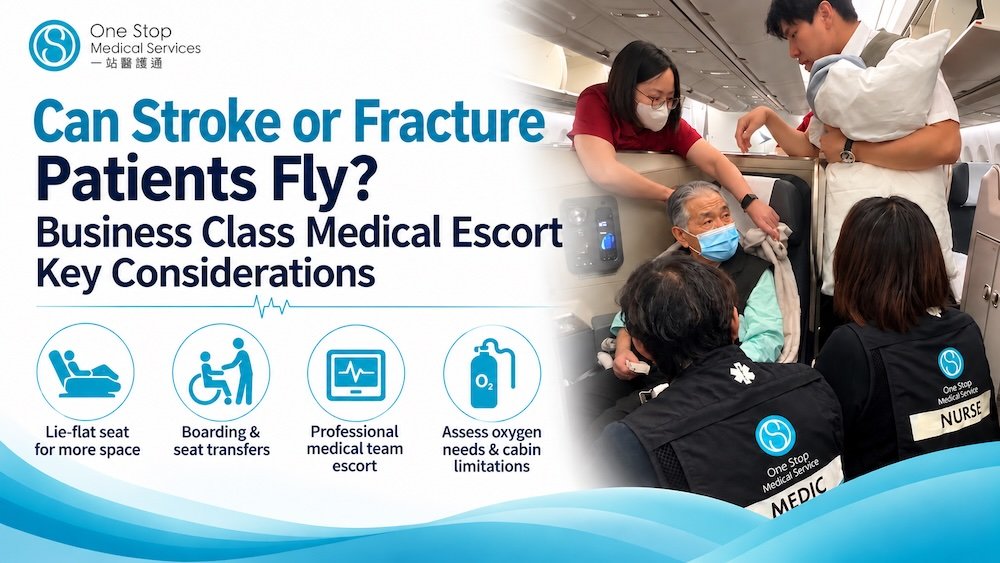
Some long-haul flights have business class seats that convert into fully flat beds, providing more room to rest than standard economy seating. For patients who have completed appropriate medical assessment and do not require the level of care provided by a dedicated air ambulance, this may be an option worth exploring.
For example, someone recovering from a stroke may be medically stable yet need assistance walking or transferring into a seat. A patient with a fracture may need particular care with lifting or repositioning. In such cases, families can discuss with healthcare professionals whether an appropriate business class seat and medical escort service are feasible.
The ability to lie flat is a comfort feature, not a substitute for fitness-to-fly assessment. During taxiing, take-off, landing or turbulence, travellers must position their seats and wear seat belts as required for safety.
2. The assessment concerns the entire journey
Before considering business class escort, the medical team generally reviews vital signs, heart and lung function, mobility, consciousness and communication, swallowing and feeding needs, and reliance on oxygen or medical devices. A recent stroke, surgery, severe fracture or unstable condition may call for closer assessment or postponement of travel.
One important question is whether the patient can safely remain upright when required during the flight. In our operational planning, tolerance of prolonged sitting may be explored initially. However, “being able to sit upright for three hours” is not a universal airline or medical clearance criterion, and cannot establish fitness to fly on its own.
The patient may also need several wheelchair and seat transfers. If each move causes significant pain, breathlessness or other risks, the proposed travel plan must be reconsidered.
3. Potential benefits of business class medical escort
First, lie-flat seating on certain services can provide room to rest and adjust position. Second, an appropriate scheduled flight may fit with planned ground transport. Third, with suitable coordination before departure, medical personnel may be able to assist with necessary care nearby.
These potential benefits depend on aircraft type, cabin layout, working space for the escort team and the patient's specific needs. Not every business class cabin offers the same conditions.
4. Important limitations
A commercial cabin is not a treatment room. Medical facilities, working space and privacy are limited. Families should be aware that the patient may need to move from an airport wheelchair to a narrow aisle wheelchair and then to the assigned seat; medical devices must comply with airline rules; and other passengers share the cabin.
A patient may not be suitable for a commercial flight if their medical requirements exceed what the aircraft or approved equipment can support, for example when oxygen needs are well above the capability of the permitted equipment. People with potentially transmissible illnesses must also comply with the airline's and relevant public-health requirements.
5. What information should families prepare?
Before contacting the escort team, it helps to gather a summary of the patient's condition, recent medical reports, current medication, oxygen needs, ability to sit up or stand, assistance needed for toileting or meals, intended departure date and proposed route. Complete information allows the team to identify likely restrictions earlier.
The right transfer method for the right patient
Recovery from a stroke, a fracture or reduced mobility does not automatically rule out air travel. Equally, the availability of a lie-flat seat does not make a flight automatically safe. The choice among commercial business class, other airline arrangements and a dedicated air ambulance should be driven by the patient's clinical and aviation safety needs.
For cross-border or overseas medical transfer enquiries, contact ONE STOP MEDICAL SERVICES. We can discuss possible escort arrangements in light of the patient's condition and intended route.
One Stop Medical Services provides professional point-to-point, seamless medical escort services. We can assist you or your family with complicated procedures and ensure that the patient receives appropriate medical monitoring and care throughout the journey back to Hong Kong.
For a free enquiry, please call or WhatsApp +852 9788 9115.