
Disclaimer: The medical information contained in this article is for general reference only and should not be regarded as medical advice. If you experience symptoms such as fever, bleeding, dizziness, chest discomfort, shortness of breath, decrease in consciousness, or any other emergency medical situations, please seek immediate medical attention from the nearest healthcare facility.
As the Greater Bay Area “one-hour living circle” continues to take shape, more and more Hong Kong families are arranging for their elderly parents to spend their retirement years in Mainland cities such as Shenzhen, Zhongshan, or Guangzhou.
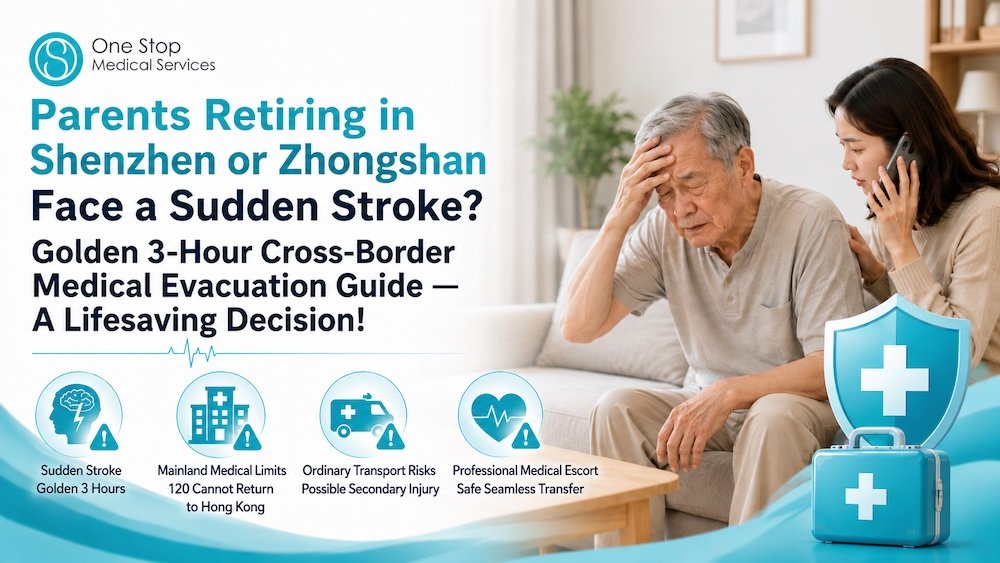
However, elderly people may face life-threatening emergencies at any time, including acute myocardial infarction, falls and fractures, or sudden stroke. When an elderly parent suffers a sudden stroke in a Mainland elderly home or at home, the “golden 3 hours” for saving brain cells can easily be consumed by the panic of family members in Hong Kong, gaps in cross-border medical information, and border administrative procedures.
Understanding a safe, legal, and time-sensitive cross-border medical transfer process may become the final line of defence in protecting the lives of parents living in Mainland China.
The “Time Trap” in Mainland Stroke Rescue: The Legal Limitation of 120 Ambulances
When an elderly person in Mainland China shows signs of stroke, such as facial drooping, weakness on one side of the body, or slurred speech, family members in Hong Kong often fall into the first critical misconception: believing that calling the Mainland emergency number “120” can directly send their parents back to Hong Kong for treatment.
The fact that must be clearly understood is this: the legal responsibility of Mainland 120 ambulances is limited to transporting the patient to the nearest local hospital, such as a local Grade 3A hospital, for emergency thrombolysis or surgery. They absolutely do not provide cross-border ambulance services that directly transfer patients back to a Hong Kong hospital.
Once the patient is admitted to the intensive care unit (ICU) of a Mainland hospital, family members may immediately face significant pressure from the “pay first, treat later” upfront payment system. At the same time, they must also deal with differences in medical terminology between the two healthcare systems and the difficulty of having Mainland medical records immediately connected with Hong Kong’s Hospital Authority system.
Why Ordinary Transport Can Become a “Fatal Risk” for Critically Ill Elderly Patients
After parents in Mainland China have received initial thrombolysis treatment or their vital signs have become slightly more stable, many children will urgently want to arrange a hospital transfer back to Hong Kong because of Hong Kong’s public healthcare benefits and more familiar care environment.
At this point, families often fall into the second misconception: attempting to use an ordinary cross-border seven-seater vehicle, private car, or even high-speed rail to bring the elderly patient back to Hong Kong.
For elderly patients who have just suffered a stroke, have limited mobility, may require continuous oxygen support, or need ongoing monitoring of blood pressure and heart rate, ordinary civilian transport carries extremely high risks.
1. Secondary injury caused by movement at border checkpoints:
Non-medical vehicles cannot drive directly into a Hong Kong hospital ward. When passing through Mainland and Hong Kong border checkpoints, the elderly patient may need to be lifted or moved multiple times. This can easily trigger a sudden rise in blood pressure or even secondary cerebral bleeding.
2. No emergency medical support inside the vehicle:
Ordinary vehicles do not carry life-support equipment such as onboard oxygen or patient monitoring devices. If the patient’s condition suddenly deteriorates on the Guangzhou–Shenzhen expressway, non-professional family members or drivers will have no emergency medical capability to respond.
Professional Cross-Border Medical Escort: A Seamless and Safe “Hospital A to Hospital B” Transfer
To truly protect the golden recovery period of an elderly stroke patient, family members must activate a professional hospital-to-hospital, point-to-point medical transfer solution.
This requires a professional medical escort vehicle with valid cross-border operating arrangements within the Greater Bay Area, equipped with ICU-level medical equipment, and staffed by Hong Kong-registered doctors or nurses who can monitor the patient’s vital signs throughout the journey.
Only by avoiding complicated border administrative barriers and eliminating the need for the patient to get out of the vehicle at checkpoints can high-risk elderly patients be transferred in the most stable and safest condition, with seamless handover to a Hong Kong public or private hospital.
One Stop Medical Services provides professional bed-to-bed medical escort services, helping patients and their families navigate complex transportation and administrative arrangements with ease. Our experienced medical team ensures that patients receive appropriate medical supervision, care and support throughout their journey.
For a free consultation, please call or WhatsApp us at +852 9788 9115.