
Disclaimer: The medical information contained in this article is for general reference only and should not be regarded as medical advice. If you experience symptoms such as fever, bleeding, dizziness, chest discomfort, shortness of breath, decrease in consciousness, or any other emergency medical situations, please seek immediate medical attention from the nearest healthcare facility.
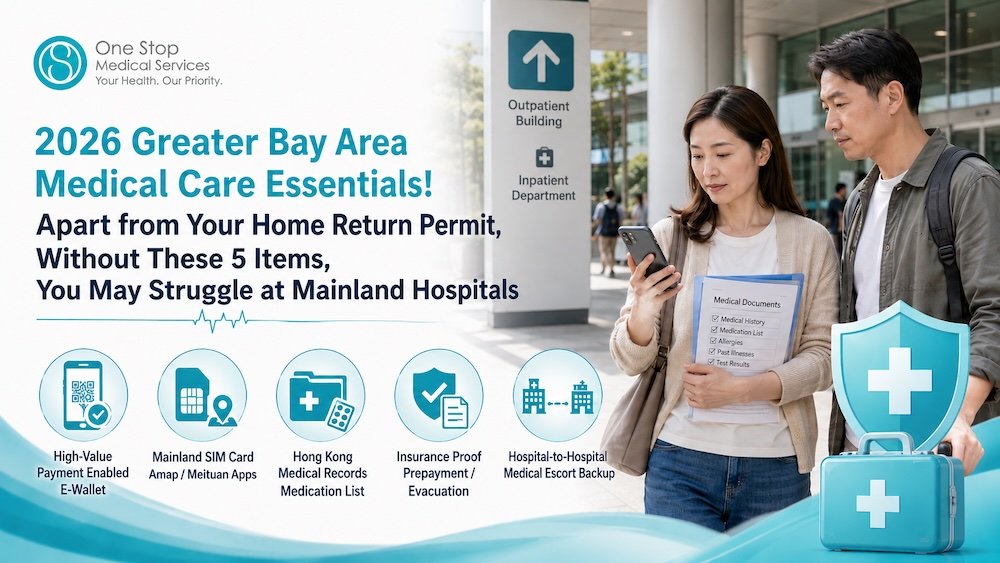
2026 Greater Bay Area Medical Care Essentials: Apart from Your Home Return Permit, Without These 5 Items, You May Struggle at Mainland Hospitals!
Travelling north to the Greater Bay Area for shopping and leisure has become routine for Hong Kong residents. However, the huge gap between the medical systems on the two sides of the border is a hidden risk that many people automatically overlook when crossing the boundary. Mainland hospitals, including Grade 3A hospitals such as the University of Hong Kong-Shenzhen Hospital and Shenzhen People’s Hospital, operate very differently from Hong Kong in terms of registration, diagnosis, medication, and payment systems. Many Hong Kong residents mistakenly believe that bringing a Home Return Permit and purchasing travel insurance will allow them to move through Mainland emergency departments without difficulty. However, once a sudden serious illness or severe injury occurs, if the following 5 essential items are missing, family members may fall into a desperate situation of administrative obstacles and frozen funds within the first 24 hours of admission, and may even be forced to remain locally without being able to transfer the patient back to Hong Kong.
1. A Mainland E-Wallet with High-Value Payment Functions Enabled (WeChat Pay / Alipay)
Mainland public Grade 3A hospitals strictly follow a “pay first, treat later” prepayment system. From emergency registration, blood tests, and CT scans to arranging emergency surgery or admission to the intensive care unit (ICU), before every medical procedure can move forward, family members must first go to the front desk or use a mobile phone to settle the “hospital admission prepayment”.
The post-payment system used by Hong Kong’s Hospital Authority, or credit card payments commonly accepted by Hong Kong private hospitals, may often encounter obstacles in Mainland emergency departments due to cross-border transaction limits or terminal support issues. Family members must carry WeChat Pay or Alipay accounts that are linked to a Hong Kong or Mainland bank card and have “daily high-value cross-border payment” functions enabled. They should also ensure that the account has tens of thousands of RMB in liquid funds. Otherwise, medical procedures may come to an immediate halt due to unpaid fees.
2. A Real-Name Registered Mainland SIM Card and Amap / Meituan Apps
The Mainland medical system has become highly digitalised. Appointment booking, electronic medical records, prescription collection, and even queue number calling in Grade 3A hospitals are all deeply connected to WeChat mini-programs or dedicated hospital apps. The only gateway to registering for these systems is the ability to receive Mainland mobile verification codes.
If you only have an ordinary Hong Kong SIM card that cannot receive Mainland SMS messages, you may not even be able to complete basic real-name registration at an emergency department. At the same time, Amap or Meituan should be installed on your phone so that, within the “golden 5 minutes” after an accident occurs, you can accurately search for and locate the nearest Grade 3A hospital with emergency treatment capabilities. Do not choose a small community clinic lacking critical care capability simply for convenience.
3. Complete Copies of Previous Hong Kong Medical Records and a Long-Term Medication List (Cloud Backup on Hand)
When sudden cardiovascular or cerebrovascular diseases, such as stroke or myocardial infarction, or severe trauma occur, Mainland attending doctors need to understand the patient’s drug allergy history and chronic disease records as quickly as possible. The Mainland medical system and Hong Kong’s Hospital Authority eHealth system are not interconnected, so Mainland doctors cannot access any of the patient’s medical records in Hong Kong.
Family members must prepare in advance by photographing and storing the patient’s Hong Kong medical records, surgical records, and current medication list on a mobile phone or in the cloud, especially for anticoagulants and blood pressure medication. When medical terminology differs between the two systems, this clear and structured medical record may become the only basis for Mainland doctors to carry out precise emergency treatment and avoid drug conflicts.
4. Insurance Documents with “Cross-Border Prepayment Deposit” and “Emergency Evacuation” Clauses
Many people believe that purchasing travel insurance means everything is covered, but they overlook the fact that most policies operate on a “pay first, claim later” basis. Daily ICU expenses in Mainland China can easily exceed tens of thousands. If the policy does not support a “Guarantee of Payment” for hospital medical expenses, family members may face a severe cash-flow crisis.
In addition, it is essential to confirm whether the policy includes an “Emergency Medical Evacuation” clause. When a Mainland hospital determines that local medical capability is sufficient, the insurance company has the right to refuse approval for ambulance transfer costs back to Hong Kong on the grounds of “no medical necessity”. Reading the policy terms clearly and preparing the direct contact details of the insurance broker are necessary in order to activate the claims process immediately when an incident occurs.
5. A Definite Cross-Border “Hospital-to-Hospital” Point-to-Point Medical Escort Contingency Plan
After a critically ill or injured patient has received initial emergency treatment in Mainland China and their condition has become slightly more stable, transferring back to Hong Kong becomes the natural choice in order to access Hong Kong’s medical benefits and a familiar care environment. At this point, family members will face the final hurdle: Mainland 120 ambulances absolutely do not provide cross-border transfers to Hong Kong, while ordinary cross-border seven-seater vehicles or private cars require patients to get out at border checkpoints, and the vehicle cabins have no life-support equipment at all.
For critically ill elderly patients who rely on ventilators, require continuous infusion of specialised medication, or have limited mobility, forcing them to travel in civilian vehicles is equivalent to placing their lives at extremely high risk. Family members must include the contact details of a professional cross-border medical escort team in their checklist as the final emergency safety net. Overcoming the barriers between the two medical systems and border administration requires a robust solution that can achieve seamless “Hospital A to Hospital B” transfer.
One Stop Medical Services provides professional bed-to-bed medical escort services, helping patients and their families navigate complex transportation and administrative arrangements with ease. Our experienced medical team ensures that patients receive appropriate medical supervision, care and support throughout their journey.
For a free consultation, please call or WhatsApp us at +852 9788 9115.