
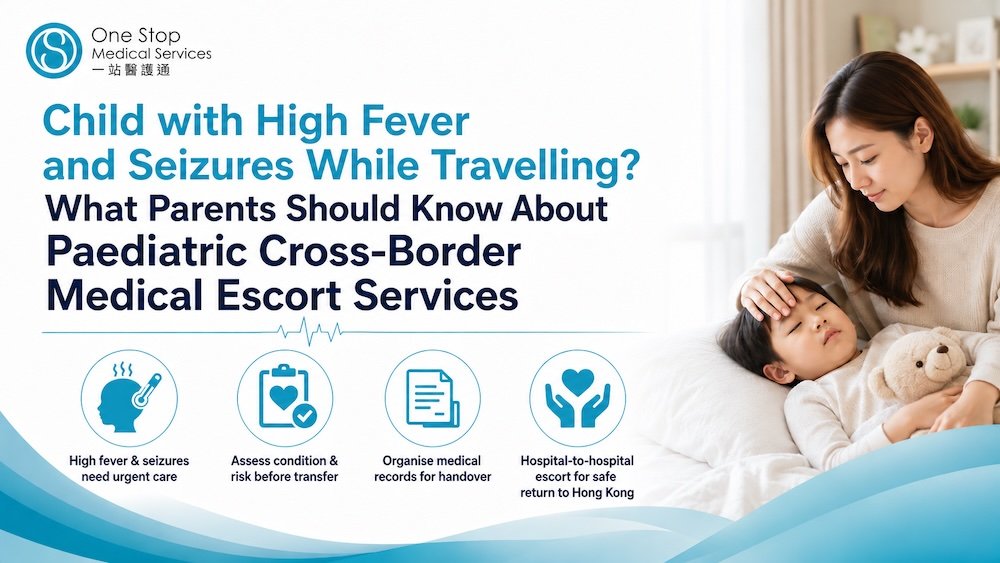
More Hong Kong families are travelling to Shenzhen and other parts of Guangdong with young children during long holidays. However, children may suddenly develop a fever due to infection while travelling. When a child develops convulsions during a fever (febrile seizures), repeated vomiting, persistent lethargy or even confusion, parents who are away from home can understandably become extremely anxious.
A febrile seizure does not in itself mean that a child has encephalitis or meningitis, and most brief febrile seizures do not cause brain damage. However, serious infections such as encephalitis and meningitis may also present with fever, seizures and altered consciousness. Children showing these symptoms should therefore be assessed promptly by medical professionals. Some serious central nervous system infections can deteriorate rapidly, so timely investigation and treatment are important. In an emergency, parents should remain calm, arrange immediate assessment and treatment at the nearest appropriate medical facility, and only then consider cross-border medical transfer according to the child’s clinical condition.
Mainland 120 and Cross-Border Transfer: Emergency Ambulance Care and Hospital-to-Hospital Transfer Are Different Processes
When a child suddenly develops a high fever and seizures in Mainland China, parents will often call the emergency number 120. However, ordinary pre-hospital emergency care and cross-border medical transfer are different arrangements. Families should be aware of two key points:
1. Calling 120 does not mean a child can be taken directly across the border to Hong Kong
Mainland 120 services primarily provide pre-hospital emergency care and transport patients to an appropriate local medical facility according to urgency, proximity and medical needs. Cross-boundary direct ambulance arrangements are now available within the Guangdong-Hong Kong-Macao Greater Bay Area for certain eligible patients between designated hospitals, but such transfers require assessment by medical teams on both sides, confirmation by the receiving hospital and coordination by the relevant authorities. A family therefore cannot simply call 120 and request direct transport to a Hong Kong hospital.
2. Payment and hospital administrative arrangements differ between the two healthcare systems
Admission, investigations, medication and payment procedures vary between Mainland hospitals. Hong Kong families may need to deal with deposits, immediate payments, insurance claims and other administrative matters. Nevertheless, patients requiring urgent emergency treatment should receive necessary emergency care first, and essential treatment should not be delayed because of payment issues.
Parents may therefore have to manage not only the child’s medical condition, but also medical expenses, admission procedures, medical records and possible cross-border transfer arrangements.
Why Critically Ill Children Should Not Be Taken Back to Hong Kong in Ordinary Transport
After a child has received initial treatment at a Mainland hospital or the condition appears to have stabilised, parents may wish to arrange transfer back to Hong Kong because they are more familiar with the Hong Kong healthcare system, communication is easier, and they prefer to continue treatment in Hong Kong.
At this stage, the priority should not be to return to Hong Kong as quickly as possible, but to have medical professionals assess whether the child is fit for long-distance and cross-border transfer. For a child with suspected encephalitis, unstable vital signs, a risk of recurrent seizures, or a need for ongoing respiratory or oxygen support, travelling in an ordinary cross-border seven-seater, a dual-plate private vehicle or by wheelchair through the boundary may involve significant risks:
- Repeated movement and border procedures can increase the burden on the child: Non-medical transport may require the child to be moved several times during border clearance, vehicle changes or inspections. For a clinically unstable child, unnecessary movement can make care during the journey more difficult.
- Lack of continuous medical monitoring and emergency response capability: Ordinary vehicles are not equipped with oxygen, monitoring or emergency equipment tailored to the child’s clinical needs, and there may be no healthcare professional continuously monitoring vital signs. If seizures recur, breathing worsens or consciousness declines during the journey, parents and ordinary drivers may not be able to provide the necessary medical response.
Hospital-to-Hospital Professional Cross-Border Medical Escort: Continuing Treatment in Hong Kong When Clinically Appropriate
For a child who has been assessed by the medical team and is considered suitable for cross-border transfer, a point-to-point hospital-to-hospital medical escort may be considered to reduce unnecessary movement and interruptions in medical monitoring.
Cross-border medical escort arrangements should be tailored to the patient’s actual condition, with an appropriate transport plan and the required level of medical support. Relevant medical equipment can be arranged according to clinical needs, with suitable healthcare professionals monitoring the patient during the journey.
The medical escort team may also assist with organising and handing over treatment records from the Mainland, as well as coordinating discharge, admission and cross-border arrangements. This helps reduce unnecessary movement during transfer and allows the child, where safe and feasible, to return to Hong Kong for ongoing treatment.
If continuous oxygen, vital-sign monitoring or other medical support is required, appropriate healthcare personnel and equipment can be arranged according to the child’s condition. Where necessary, the team can also communicate medical records and transfer information with the treating team in the Mainland and the receiving healthcare institution in Hong Kong. Advance planning of medical, transport and border arrangements can help reduce the risk of interruptions in care during the transfer.
One Stop Medical Services provides professional point-to-point, seamless medical escort services. We can assist you or your family with complicated procedures and ensure that the patient receives appropriate medical monitoring and care throughout the journey back to Hong Kong.
For a free enquiry, please call or WhatsApp +852 9788 9115.