
Disclaimer: The medical information contained in this article is for general reference only and should not be regarded as medical advice. If you experience symptoms such as fever, bleeding, dizziness, chest discomfort, shortness of breath, decrease in consciousness, or any other emergency medical situations, please seek immediate medical attention from the nearest healthcare facility.
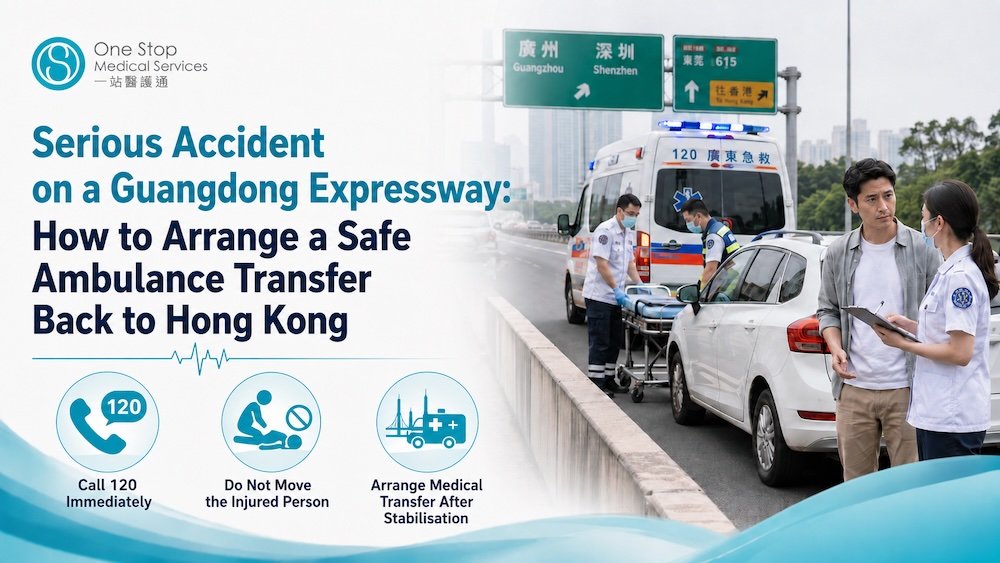
With the widespread adoption of the Northbound Travel for Hong Kong Vehicles scheme, Hong Kong private cars can now frequently be seen on expressways throughout Guangdong Province, including the Guangzhou–Shenzhen Yanjiang Expressway and the Beijing–Hong Kong–Macao Expressway. However, vehicles travel at very high speeds on Mainland expressways, where heavy goods vehicles are also common. If a serious traffic accident unfortunately occurs, barriers between the medical rescue systems on the two sides of the border may become the greatest life-or-death challenge faced by Hong Kong residents.
Many drivers mistakenly believe that after calling the emergency services in Mainland China, an ambulance can take the injured person directly back to a hospital in Hong Kong, just as they might expect locally. This serious misconception may leave an injured person stranded away from Hong Kong during the critical rescue period.
1. The First Step at the Scene of an Expressway Accident in Guangdong and the Limitations of Calling 120 in Mainland China
When a traffic accident occurs on an expressway in Guangdong Province and a relative or companion is seriously injured, family members or accompanying persons must immediately activate the Mainland emergency response system. However, there is a harsh reality that Hong Kong residents must understand:
- Mainland 120 ambulances do not cross the border: An ambulance summoned by calling the Mainland emergency number “120” is legally responsible only for transferring an injured person from the accident scene to the nearest Mainland hospital, usually a local township hospital or district-level Grade 3A hospital, for emergency treatment. It cannot provide a cross-border service or take the injured person directly to a Hong Kong hospital.
- Moving the injured person without professional assistance may cause secondary injuries: Expressway accidents can easily cause serious cervical spine or spinal injuries, as well as hidden internal bleeding. Without professional immobilisation equipment or on-site guidance from emergency personnel, family members who panic and attempt to pull the injured person out of the vehicle or lift them may cause a fractured bone to pierce a major blood vessel, resulting in permanent paralysis or immediate suffocation.
2. The Difficulty of Being Stranded in a Mainland Hospital and the Administrative and Payment Barriers
After the injured person has been transported by a 120 ambulance to the emergency department of a local Mainland hospital, the family may face a second wave of administrative and financial pressure:
- Real-name registration and advance-payment system: Mainland hospitals strictly implement a “payment before treatment” system. Before undergoing a CT scan, entering an operating theatre or being admitted to an intensive care unit, the family may be required to pay an inpatient deposit amounting to tens of thousands of dollars at the payment counter. Otherwise, there is a risk that the medical process may be delayed.
- Medical-record and language communication barriers: Medical records and computer scan reports issued by Mainland hospitals use Mainland medical terminology, making it difficult for Hong Kong family members to assess the patient’s condition accurately. At the same time, the Hong Kong Hospital Authority and public hospitals do not accept a Mainland diagnosis document as a direct basis for hospital admission, creating a significant gap in medical information between the two healthcare systems.
3. How Can a Legal and Safe Point-to-Point Hospital-to-Hospital Cross-Border Medical Transfer Be Arranged?
After the injured person has received an initial operation or bleeding control at a Mainland hospital and their condition has become relatively stable, meaning they are medically fit for transport, transferring them back to Hong Kong for continued treatment is the only way to reduce medical expenses and return them to a familiar care environment.
However, passengers travelling in ordinary vehicles, such as cross-border seven-seater vehicles or private cars, are required to leave the vehicle when passing through border control. These vehicles also have no life-support equipment or professional medical monitoring.
For seriously injured patients who have suffered fractures, concussion or require ventilator support following a major traffic accident, attempting a cross-border transfer in a non-medical vehicle is equivalent to placing the family member’s life at extremely high risk.
To overcome the barriers between the two medical systems and border administration procedures, the family needs a seamless point-to-point transfer solution that meets the highest safety standards, taking the patient directly from Hospital A to Hospital B.
One Stop Medical Services provides professional bed-to-bed medical escort services, helping patients and their families navigate complex transportation and administrative arrangements with ease. Our experienced medical team ensures that patients receive appropriate medical supervision, care and support throughout their journey.
For a free consultation, please call or WhatsApp us at +852 9788 9115.
#NorthboundTravel #GuangdongExpressway #RoadTrafficAccident #MainlandAmbulance #EmergencyMedicalTransfer #CrossBorderMedicalTransfer #CrossBorderAmbulance #MedicalEscort #HospitalToHospitalTransfer #ReturnToHongKongForTreatment #OneStopMedicalServices