
hkmedicalescort
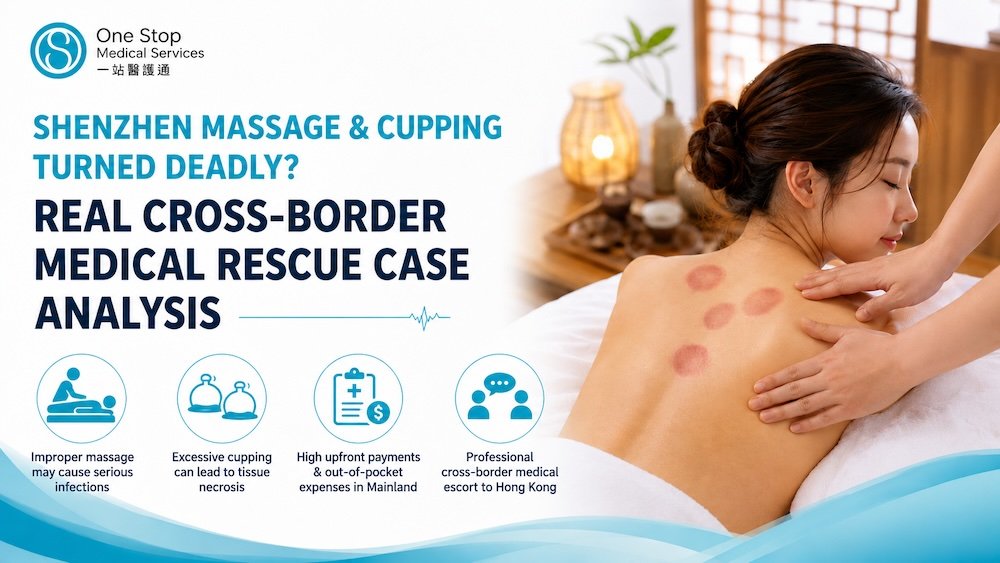
For Hong Kong residents travelling north to Shenzhen, high-value dining is not the only attraction. Spa treatments, massage, traditional Chinese medicine cupping and scraping are also regular parts of the itinerary. However, these seemingly harmless ways to relax can carry extremely high risks of infection and trauma. Some technicians at spa centres and beauty salons in Mainland China lack formal anatomical knowledge, while their equipment may not be thoroughly disinfected. This can easily result in blood vessels being damaged during massage, or excessive cupping causing severe deep-tissue necrosis and acute sepsis. When what began as a relaxing trip develops into a life-threatening tragedy, family members who lack professional knowledge of cross-border medical transfer may inadvertently place the injured person in an even more serious situation of being stranded.
A Fatal Chain Reaction Caused by Practitioner Error: From Lower Back Pain to ICU Emergency Treatment
When a person in Mainland China develops serious complications caused by cupping or massage, such as rhabdomyolysis, necrotising fasciitis, or a stroke caused by arterial dissection, the patient will usually be rushed to a local Grade 3A hospital. At this point, the family may suddenly face a major cultural and administrative shock caused by the differences between the two medical systems:
1. Mainland China’s Strict “Advance Payment System” and Self-Funded Items
Mainland hospitals, whether for emergency treatment or inpatient care, uniformly operate on a “pay first, receive treatment afterwards” basis. Before debridement in the intensive care unit (ICU), the use of advanced antibiotics, or emergency vascular surgery, family members must first pay a deposit of tens of thousands of renminbi. More difficult still, advanced life-support equipment and specific specialist medicines required to rescue a patient with severe muscle necrosis are mostly self-funded items outside the medical insurance catalogue. The family must pay the full amount immediately, and the Hong Kong Hospital Authority and public hospitals do not provide reimbursement for treatment received outside Hong Kong.
2. The Information Gap Caused by Hong Kong Public Hospitals “Not Recognising Mainland Medical Records”
When a family member is critically ill in Mainland China, anxious relatives often call Hong Kong public hospitals for help and ask them to receive the patient. However, Hong Kong public hospitals do not recognise diagnostic documents issued by Mainland hospitals and cannot directly read Mainland computed tomography (CT) or magnetic resonance imaging (MRI) images. Without professional coordination between medical teams, even if the family forcibly transports the patient to a Hong Kong boundary control point, emergency department staff in Hong Kong will not know the medication used in Mainland China, the progress of debridement, or the type of infectious bacteria involved, and therefore cannot immediately begin precise continuation of treatment.
Why Is Returning to Hong Kong Blindly a Form of Secondary Harm? The Fatal Risks of Civilian Vehicles
When facing a critically ill relative or friend, family members in panic often make the most dangerous mistake: attempting to hire an ordinary cross-border seven-seater, a private car licensed for both Hong Kong and Mainland China, or even trying to accompany the patient across the boundary in a wheelchair.
For critically ill patients who face sepsis caused by muscle necrosis, require continuous antibiotic infusion, depend on onboard oxygen, or have extremely unstable vital signs, ordinary civilian transport carries irreversible risks:
- Compulsory transfer at the boundary and secondary trauma caused by jolting: Non-medical vehicles cannot drive directly into a Hong Kong hospital ward. When crossing boundary control points, patients are often forced to leave the vehicle or undergo customs inspection inside a confined cabin. Repeated movement and jolting during the journey can easily accelerate the return of toxins from necrotic tissue to the heart, leading to acute renal failure or cardiac arrest.
- No medical emergency capability: Civilian vehicles do not have emergency monitors or life-support equipment. If the patient deteriorates on the Guangzhou–Shenzhen Expressway, an untrained driver or family member can only watch helplessly as their relative falls into a desperate situation.
Activate Professional “Hospital-to-Hospital” Cross-Border Medical Escort: Direct Access to a Life-Saving Operating Theatre in Hong Kong
To completely break through the administrative and medical barriers between the two sides of the boundary, the only route to survival is to activate an “A-point hospital to B-point hospital” point-to-point seamless escort service that meets the highest safety standards.
This highly demanding transfer must be carried out by a professional cross-border medical transfer vehicle with legal licences in both Guangdong and Hong Kong and an interior equipped with ICU-level life-support equipment, including an advanced ventilator, onboard oxygen and an emergency monitoring system. Throughout the transfer, a Hong Kong-registered doctor or nurse monitors the patient’s vital signs in real time without interrupting life support. The team also completes a one-to-one medical terminology handover of the patient’s records in advance with the attending doctor in Mainland China and the emergency department of the receiving hospital in Hong Kong. Only by avoiding the ordeal of changing vehicles at the boundary and handling all complicated hospital admission, discharge and customs clearance procedures can a critically ill family member be transported rapidly and safely to a Hong Kong hospital for continued treatment.
One Stop Medical Services provides professional bed-to-bed medical escort services, helping patients and their families navigate complex transportation and administrative arrangements with ease. Our experienced medical team ensures that patients receive appropriate medical supervision, care and support throughout their journey.
For a free consultation, please call or WhatsApp us at +852 9788 9115