
Disclaimer: The medical information contained in this article is for general reference only and should not be regarded as medical advice. If you experience symptoms such as fever, bleeding, dizziness, chest discomfort, shortness of breath, decrease in consciousness, or any other emergency medical situations, please seek immediate medical attention from the nearest healthcare facility.
As the trend of retirement and elderly care in the Greater Bay Area becomes increasingly common, many Hong Kong families have placed their elderly parents with Alzheimer’s disease (dementia), long-term bedridden conditions or mobility difficulties in residential care homes on the Mainland. However, when an elderly person’s condition deteriorates and they need to return to Hong Kong for continued treatment at a public or private hospital, families often face an extremely difficult hospital-transfer challenge. Older patients with dementia, osteoporosis or long-term bedridden conditions may simply be unable to tolerate the strain of conventional transport. Achieving a “pain-free, zero-secondary-trauma” cross-border transfer under both administrative barriers at the boundary and severe physical limitations requires highly specialised medical escort expertise.
The Deadly Cost of Improper Transfer: Two Major Cross-Border Transport Risks for Elderly Patients
In an emergency, many families may try to hire an ordinary cross-border seven-seater or a private vehicle licensed in both Hong Kong and the Mainland, believing that the elderly person can simply “lie down in the back seat” for the journey back to Hong Kong. Such transfer without professional medical intervention can easily lead to the following serious consequences:
1. Triggering “Acute Delirium” and Emotional Distress in Patients with Dementia
Older adults with dementia can be extremely sensitive to changes in their surroundings. The confined space of an ordinary passenger vehicle, several hours of bumpy motorway travel, together with possible queuing at Lok Ma Chau or Shenzhen Bay Port, opening the window and being exposed to wind, or being questioned by customs officers, may easily cause intense fear and hallucinations. This can directly trigger “acute delirium”, causing the elderly person to struggle violently inside the vehicle or attempt to open the door. Their blood pressure may rise sharply, significantly increasing the risk of secondary cerebrovascular bleeding or myocardial infarction.
2. Shear Injuries and Worsening Pressure Sores in Long-Term Bedridden Patients
The skin of severely ill, long-term bedridden older patients can be extremely fragile. The suspension system of a civilian vehicle is not designed for medical transport. Vertical jolting and lateral movement during turns can create substantial friction and shear force between the patient’s body and the seat surface. During a cross-boundary journey lasting several hours, this may not only cause existing pressure sores (bedsores) to worsen rapidly or even tear and bleed, but an improper sitting position may also compress the airway and lead to hidden hypoxia.
Breaking Down the Highly Technical Medical Requirements of “Pain-Free Cross-Border Transfer”
To achieve a genuinely “pain-free” hospital transfer for high-risk elderly patients, a professional medical transport team is required to raise the entire process to the level of clinical medical protection and provide precise, seamless point-to-point transfer from Hospital A to Hospital B:
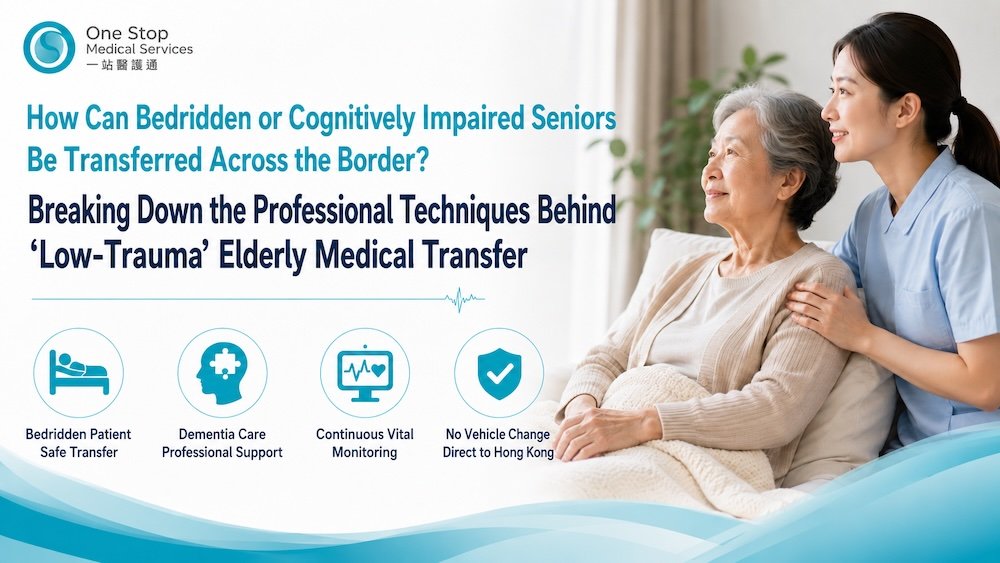
- Advanced Anti-Jolt Air Cushion : Professional cross-border medical vehicles are equipped with advanced medical air mattresses designed to prevent pressure sores. These can absorb micro-vibrations from motorway travel as much as possible, reduce shear force and protect the elderly patient’s fragile bones and skin.
- “Whole-Journey” Psychological Stress Management and Professional Escort: For patients with dementia, the entire journey should be monitored by healthcare professionals experienced in psychological reassurance. Without using compulsory medication restraints, professional orientation guidance and real-time monitoring of vital signs, including blood pressure, blood oxygen and ECG, are used to keep the elderly patient as calm and reassured as possible while life-support measures remain uninterrupted.
- Border “No Need to Leave the Vehicle” Direct-Through Access with Cross-Boundary Plates: Truly safe medical escort requires the relevant Greater Bay Area medical direct-through licence. From the patient’s bed on the Mainland to the hospital bed in Hong Kong, the patient does not need to leave the vehicle for immigration clearance, avoiding the additional strain of changing vehicles at the border. Border declarations and hospital admission and discharge procedures are handled in advance by the professional team, reducing clearance time as much as possible.
Do Not Gamble with a Life: Put a Predictable Return-to-Hong-Kong Plan in Place
Cross-border transport for elderly patients is far more than a simple “passenger transfer”. It is a rigorous cross-boundary medical rescue operation. Families should not entrust their parents’ safety to ordinary civilian vehicles or unregulated black-market ambulances without standardised procedures. Choosing a legitimate organisation with qualified professionals, high-level equipment and a comprehensive risk-management plan is the only way to give a beloved elderly family member the best chance of returning to Hong Kong safely.
One Stop Medical Services provides professional bed-to-bed medical escort services, helping patients and their families navigate complex transportation and administrative arrangements with ease. Our experienced medical team ensures that patients receive appropriate medical supervision, care and support throughout their journey.
For a free consultation, please call or WhatsApp us at +852 9788 9115.