
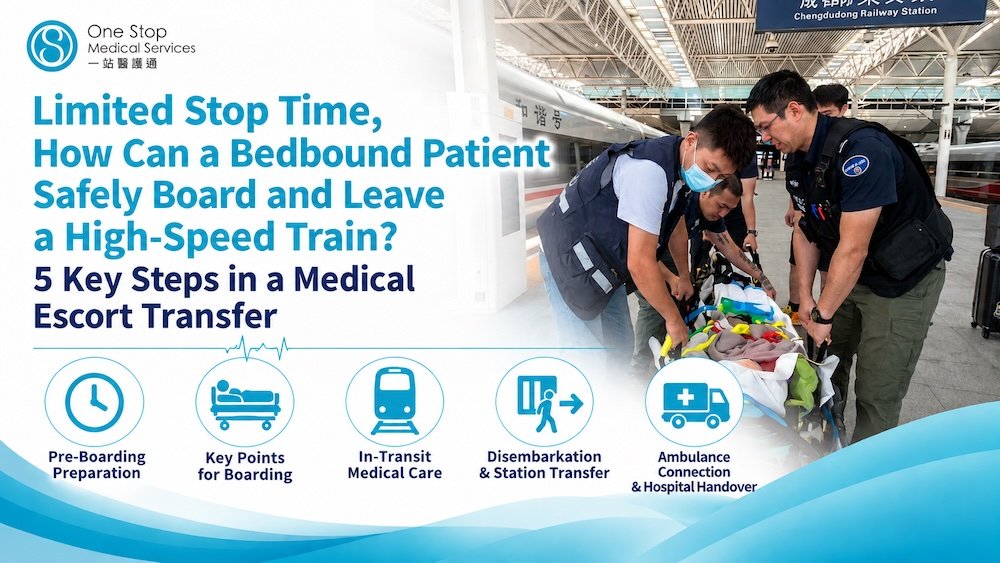
For an ordinary passenger, getting off a high-speed train simply means picking up a bag and walking out of the carriage.
For a patient who must remain lying flat, requires a stretcher, is connected to medical equipment, or needs continuous medical monitoring, boarding and disembarkation become some of the most carefully coordinated parts of the entire transfer.
A train cannot remain at the platform indefinitely simply because a patient needs more time to move. Safe transfer therefore depends on preparation before the doors open: the people, equipment, route and patient-handling plan must already be in place.
In a recent high-speed rail medical escort from a Hong Kong hospital to a hospital in Mainland China, every key timing point had to be planned in advance so that the bedbound patient could be moved safely within the limited boarding and disembarkation window.
Preparation Begins About 15 Minutes Before Boarding
The boarding process for a bedbound patient does not begin only when the train enters the platform.
In this case, the patient was first prepared in the waiting area. Approximately 15 minutes before the train arrived, relevant personnel moved into position at the platform for the final boarding preparations.
This included confirming staff responsibilities, organising the stretcher and medical equipment, maintaining the patient’s required position, and making sure everything that needed to travel with the patient was ready.
For a medical transfer, one unprepared device or one last-minute change of position can make the boarding process much more rushed. The safest way to save time is not simply to move faster, but to prepare the workflow in advance.
During Transfer, the Team Must Manage Both the Patient and the Equipment
An ordinary traveller only needs to manage personal luggage. A bedbound patient may need to be moved together with a stretcher, intravenous therapy, monitoring devices and other medical equipment required for the journey.
During movement, medical personnel need to protect the patient’s position, lines and equipment and avoid unnecessary pulling or interruption of ongoing care.
The patient, staff and equipment therefore cannot be planned separately. The team needs to know who is responsible for the patient, who manages the equipment, who supports the route and who coordinates the carriage position.
This is one of the major differences between professional medical escort and simply accompanying someone on a train.
Preparation for Disembarkation Starts Before the Train Arrives
Once the patient is on board, the work is not finished.
In this case, the medical team was notified approximately 30 minutes before reaching the destination so that preparations for disembarkation could begin.
The team needed to reorganise the patient and equipment, check the patient’s condition and prepare for an orderly transfer as soon as the train stopped.
Receiving personnel were also positioned at the platform in advance so that the limited station time could be used for the actual transfer rather than for last-minute coordination.
Completing the Transfer in About 5 to 10 Minutes Requires Coordination, Not Rushing
For this particular journey, the relevant disembarkation and transfer procedures needed to be completed within approximately five to ten minutes.
Five to ten minutes may sound generous for an ordinary passenger. For a patient requiring a stretcher, several staff members and medical equipment, however, the time window is much tighter.
The team therefore needs to know in advance where the patient will leave the carriage, who moves the equipment first, who controls the stretcher, who receives the patient on the platform and how the next transfer route will proceed.
The objective is not simply speed. It is to prevent confusion and ensure that every movement of the patient has a clear plan within the available time.
The Ambulance May Not Be Able to Reach the Platform
Families may assume that an ambulance can simply wait beside the train and collect the patient immediately. In practice, access arrangements vary between stations.
In this case, the connecting ambulance could not drive directly to the platform. After leaving the train, the patient first had to be transferred onto a stretcher trolley and escorted through the station before meeting the pre-arranged ambulance outside.
Although this may appear to be only a short distance, it remains part of the medical transfer for a bedbound patient. Positioning, equipment, monitoring and route planning all need to continue without interruption.
This is why successfully getting off the train does not mark the end of the medical escort.
The Transfer Ends Only After Handover at the Receiving Hospital
After leaving the railway station, the medical escort team continues with the patient in the connecting ambulance according to the planned arrangement.
The journey is only complete when the patient reaches the receiving hospital in Mainland China and a formal handover has been completed with the receiving medical team.
From the hospital bed in Hong Kong, through the railway station, train, destination station and ambulance, and finally to the hospital bed in Mainland China, each transfer is part of one continuous medical escort chain.
This is the core of a bed-to-bed medical escort service: not simply arranging one mode of transport, but linking transport and medical handovers into one continuous journey.
Five Questions Families Can Ask Before a High-Speed Rail Transfer
- Does the patient need to remain flat or maintain a specific position during transfers?
- Which tubes, infusions or medical devices must move with the patient?
- Do the departure and destination stations have suitable access arrangements for the stretcher and patient?
- Will personnel be in position before boarding and before disembarkation?
- Have the connecting ambulance and receiving hospital handover already been arranged?
The real challenge in high-speed rail medical escort is not whether a patient can simply “take the train”, but whether safety, order and continuity of care can be maintained across every transfer point.
One Stop Medical Services provides professional point-to-point, seamless medical escort services. We can assist you or your family with complicated procedures and ensure that the patient receives appropriate medical monitoring and care throughout the journey back to Hong Kong.
For a free enquiry, please call or WhatsApp +852 9788 9115.