
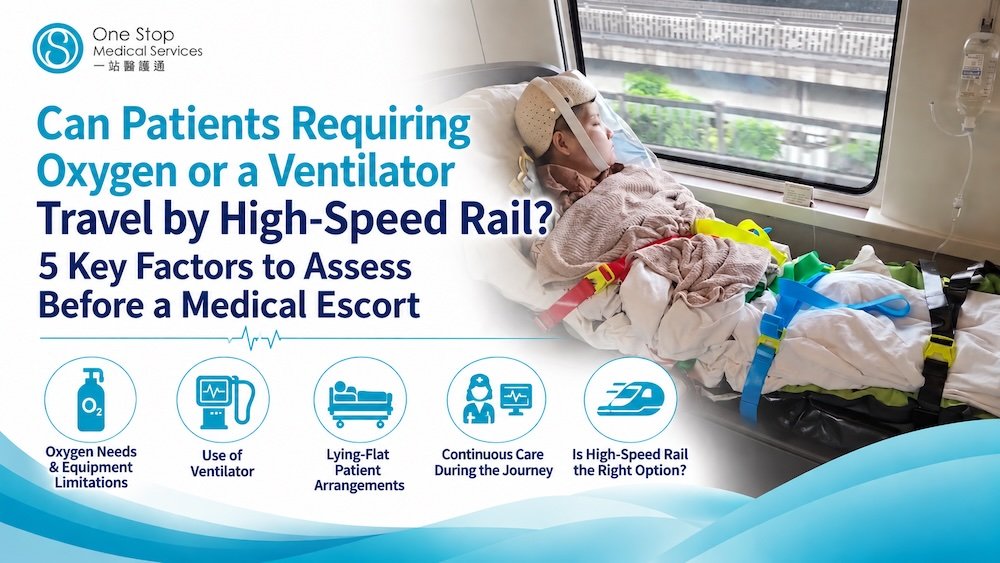
When a patient needs to be transferred from Hong Kong to a hospital in Mainland China and is already receiving oxygen, using a ventilator, or required to remain lying flat, families naturally ask whether high-speed rail is still possible.
There is no simple yes-or-no answer.
Whether high-speed rail medical escort is appropriate depends on the patient’s stability, oxygen requirement, medical equipment needs, whether that equipment can be safely used in the rail environment, and whether the entire boarding, in-transit care, disembarkation and onward transfer can be coordinated safely.
Based on practical medical escort experience, some patients who must remain lying down, are not yet fully conscious after surgery, or even require ventilatory support may be considered for high-speed rail transport if specific conditions are met and the medical team assesses the journey as appropriate. Patients with higher oxygen requirements or more complex medical needs require much more cautious assessment.
Key Factor 1: Requiring Oxygen Does Not Automatically Rule Out High-Speed Rail
The fact that a patient is receiving oxygen is not enough on its own to determine whether rail transport is possible.
The key issue is how much oxygen the patient requires and whether that requirement can be met continuously and reliably throughout the entire journey using suitable equipment.
Based on the team’s previous practical high-speed rail escort arrangements, there are real limitations on oxygen equipment in the rail environment. Hospital oxygen arrangements cannot simply be transferred directly onto the train.
The team must consider the applicable railway requirements, available equipment and the patient’s needs when arranging a suitable oxygen-generating solution.
If the patient’s oxygen requirement is relatively low and the oxygen concentrator’s output, power supply, backup plan and total journey time can all be accommodated, the medical team may then assess whether high-speed rail is feasible.
If the patient requires a high oxygen flow or would be at significant risk if oxygen delivery were interrupted or insufficient, high-speed rail may not be the appropriate transport option.
Key Factor 2: A Ventilator Is Only One Part of the Assessment
When families hear that a patient requires a ventilator, they may assume that only an ambulance or aircraft can be used.
In practice, whether a ventilated patient can travel by high-speed rail still depends on the individual case.
Important considerations include whether the patient’s vital signs are relatively stable, whether oxygen requirements are low enough to be supported, whether the ventilator and associated equipment can operate safely throughout the journey, whether battery life is sufficient, and whether appropriately trained medical staff can monitor the patient continuously.
In other words, the presence of a ventilator is not the only deciding factor. The patient’s overall condition, oxygen requirement and equipment capability are equally important.
Patients who are unstable, require frequent adjustment of ventilatory support, or depend on a high level of oxygen and medical equipment may need another form of medical transport.
Key Factor 3: A Patient Who Cannot Sit Up May Still Have a Rail Option
High-speed rail is not limited only to patients who can sit independently in a standard seat.
Based on practical escort experience, some patients who must remain flat or who are not yet fully conscious after surgery and require ongoing observation may still be assessed for high-speed rail transport if their condition and equipment requirements can be safely accommodated.
The team needs to confirm in advance how the patient will be positioned on the train, how transfers will be performed, what nursing care is required, what stretcher and medical equipment are needed, and how boarding and disembarkation will be coordinated.
Therefore, being unable to walk or sit independently does not automatically mean that high-speed rail is impossible. The key question is whether the patient’s safety and required level of care can be maintained throughout the transfer.
Key Factor 4: There Must Be No Gap in Medical Care During the Journey
For a patient requiring oxygen, a ventilator or continuous monitoring, the job is not complete once the patient has boarded the train.
During the journey, medical staff may need to continue monitoring vital signs and manage oxygen, ventilation, intravenous therapy, repositioning, feeding and other care according to the patient’s condition.
Before departure, the team also needs to calculate the full travel time and verify equipment battery life, power requirements and backup arrangements, rather than discovering during the journey that a device cannot support the entire transfer.
For these patients, the aim is continuous medical supervision and care from the time they leave the first hospital until formal handover at the receiving hospital.
Key Factor 5: Some Conditions Are Not Suitable for Public High-Speed Rail
High-speed rail is public transport, so medical suitability is not the only consideration. Public health and transportation requirements also matter.
For example, patients with communicable diseases are generally not appropriate for routine medical escort on public high-speed rail and require separate arrangements according to their condition, infection-control requirements and relevant regulations.
High-speed rail may also be inappropriate if the patient is medically unstable, has a high likelihood of requiring emergency intervention during the journey, needs more oxygen than the available equipment can safely provide, or depends on medical devices that cannot be accommodated in the rail environment.
Why Not Use an Ambulance for Every Patient?
For some inter-provincial or longer-distance hospital transfers, travelling entirely by road ambulance can involve many hours on the road.
When the patient’s condition allows, the extensive high-speed rail network, relatively frequent services and generally stable ride can make rail one possible transport option.
Compared with air transport, high-speed rail does not involve the cabin-pressure changes associated with flight. For some patients who have undergone brain surgery or have certain chest or pulmonary conditions that require special consideration before flying, the medical team may compare high-speed rail with road ambulance and air medical transport.
This does not mean that high-speed rail is always better than an ambulance or aircraft. The most appropriate option still depends on the patient’s condition, oxygen and equipment requirements, destination, travel distance, timing and the level of medical support required in transit.
The Better Question Is Not Simply, “Can Oxygen Go on the Train?”
When planning high-speed rail medical escort, the team must evaluate the patient’s needs as a whole rather than focusing on one device.
Families can help by preparing recent medical records, current oxygen flow requirements, ventilator settings, whether the patient must remain flat, any existing tubes or infusions, and information about the receiving hospital.
The question that really needs to be answered is:
“Given this patient’s current condition, oxygen requirement and equipment needs, can safety and continuity of care be maintained throughout the entire high-speed rail journey?”
Only after both the medical and logistical assessment have been completed should high-speed rail be considered as a possible cross-border medical escort option.
One Stop Medical Services provides professional bed-to-bed medical escort services, helping patients and their families navigate complex transportation and administrative arrangements with ease. Our experienced medical team ensures that patients receive appropriate medical supervision, care and support throughout their journey.
For a free consultation, please call or WhatsApp us at +852 9788 9115.