
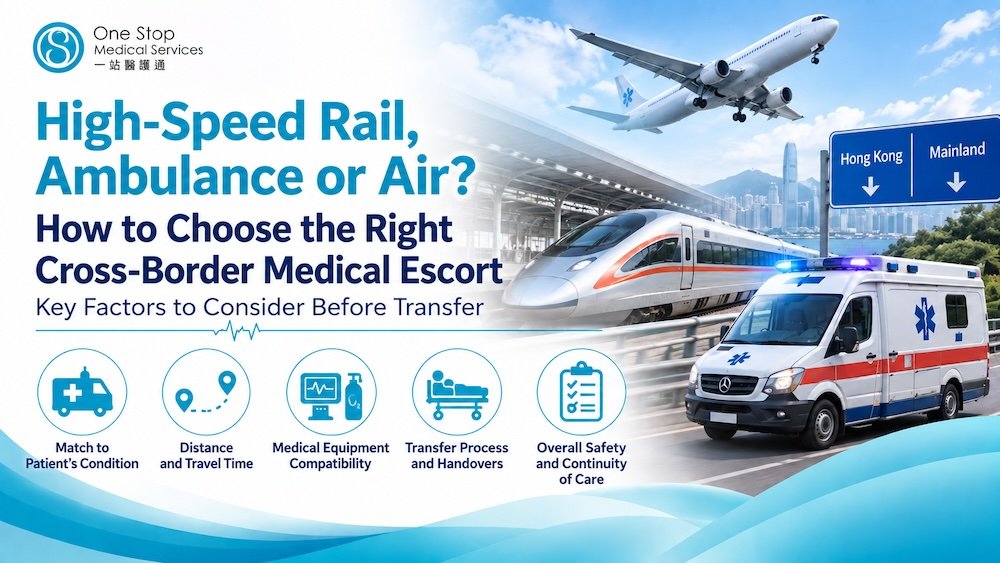
When a patient needs to be transferred from Hong Kong to a hospital in Mainland China, families often think of an ambulance first. If the destination is farther away, air transport may also come to mind. With the continued expansion of the high-speed rail network, rail has also become a possible transport option in selected medical escort cases.
However, medical escort is not simply a question of which vehicle is fastest. The patient’s condition, oxygen requirement, need to remain lying flat, medical equipment, destination, boarding and disembarkation arrangements, and whether continuous care can be maintained all influence the final decision.
There is therefore no single transport method that suits every patient. The aim is to identify the option that best matches the patient’s current medical needs and the overall transfer route.
Ambulance: Flexible Point-to-Point Transport, but Long Journeys Can Be Demanding
One of the main advantages of an ambulance is direct point-to-point transfer. A patient can be collected from a hospital or residence and transported to the destination hospital with fewer intermediate transfers. For patients who require more medical equipment, greater oxygen support or closer intervention during the journey, road medical transport can offer substantial operational flexibility.
For distant destinations in Mainland China, however, travelling the entire route by road may mean many hours inside the ambulance and can also be affected by traffic and road conditions.
For longer-distance cases, the medical team therefore needs to consider whether the patient can tolerate an extended road journey and whether another mode of transport could reduce time spent on the road.
High-Speed Rail: May Reduce Road Time on Some Routes, but Transfers Must Be Precisely Coordinated
High-speed rail offers a broad network, relatively frequent services and a generally stable ride. On some inter-provincial or longer-distance routes, rail can reduce the amount of time a patient would otherwise spend travelling entirely by road ambulance.
During an appropriately planned rail medical escort, medical personnel may continue necessary care such as monitoring vital signs, intravenous therapy, repositioning and feeding assistance.
Some patients who need to remain flat, require post-operative monitoring or, under specific conditions, require ventilatory support may be considered for rail after medical assessment.
High-speed rail also has practical limitations. Boarding and station dwell times are limited, so platform transfers, patient positioning and onward ambulance connections must be arranged in advance.
Oxygen equipment must also be compatible with the rail environment and applicable requirements. If the patient has high oxygen needs, is medically unstable or depends on equipment that cannot be safely accommodated, rail may not be appropriate.
Air Transport: Valuable for Much Longer Distances, but the Flight Environment Requires Additional Assessment
For very distant destinations, air medical transport can significantly shorten the main travel segment and therefore plays an important role in selected long-distance and international transfers.
However, the flight environment differs from ground transport. Cabin pressure changes occur during flight, so some patients who have undergone brain surgery or have certain chest or pulmonary conditions may require more detailed medical assessment before air transport is considered.
Air transport is also not a complete bed-to-bed solution by itself. The patient still needs transport from the hospital to the airport, boarding arrangements, and onward medical transport from the arrival airport to the receiving hospital.
What Should Families Actually Compare?
- Clinical stability: Is the patient stable enough for a long transfer, and how likely is emergency intervention to be needed?
- Oxygen requirement: How much oxygen is currently required, and can the necessary supply be maintained throughout the journey?
- Medical equipment: Can the ventilator, monitoring devices, infusion equipment and other devices operate safely in the chosen transport environment?
- Patient positioning: Must the patient remain lying flat, and what staffing or stretcher equipment is required for each transfer?
- Distance and timing: Would an all-road journey be excessively long, and could rail or air meaningfully shorten the main travel segment?
- Number of handovers: Every move from bed to stretcher, station or airport to vehicle, and vehicle to receiving hospital is a medical transfer that needs planning.
High-Speed Rail Is Not Simply a More Convenient Ambulance, and Faster Air Travel Is Not Automatically Better
The core of medical escort is not the transport vehicle itself. It is the ability to maintain appropriate care throughout the entire journey.
A rail journey may appear faster than an all-road ambulance route, but that advantage is irrelevant if the patient’s oxygen requirement or equipment cannot be safely supported on the train.
Likewise, air transport may cover long distances quickly, but if the patient’s condition requires additional consideration of the flight environment, rail or road options may need to be compared instead.
Professional medical escort therefore brings the patient, equipment, transport modes, transfer points and receiving hospital into one coordinated plan rather than treating the journey as simply purchasing a ticket.
From One Hospital Bed to the Next
Whether the final plan uses an ambulance, high-speed rail or air transport, the transfer should begin with the patient’s actual medical needs.
Collection from the Hong Kong hospital, monitoring during transport, transfer between vehicles, onward connections and final handover at the receiving hospital all require advance coordination.
For families, the most important question is therefore not “Which transport is fastest?” but “Which bed-to-bed route can provide the safest and most continuous care for this patient?”
One Stop Medical Services provides professional bed-to-bed medical escort services, helping patients and their families coordinate complex transfer arrangements while maintaining appropriate medical supervision and care throughout the journey.
For a free consultation, please call or WhatsApp +852 9788 9115.