
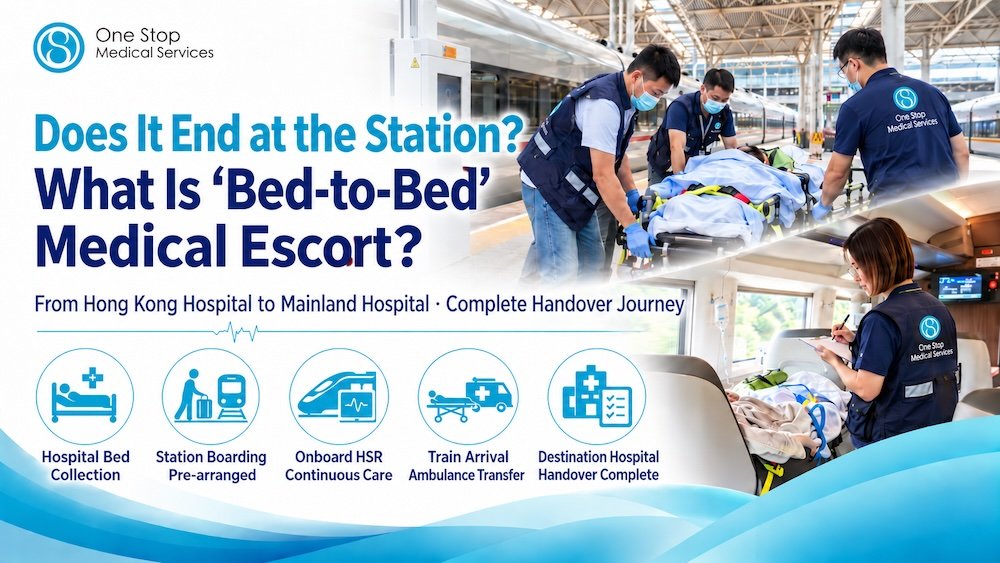
When families arrange a cross-border medical transfer for the first time, they often focus on the transport itself: ambulance, high-speed rail, or aircraft?
In practice, however, patient safety and family stress are often affected less by the vehicle in the middle of the journey and more by what happens at every handover point from the original hospital bed to the receiving hospital bed.
A recent high-speed rail medical escort from a Hong Kong hospital to a hospital in Mainland China illustrates what “bed-to-bed” service really means. The team's responsibility did not end at the railway station, nor did the family have to take over once the train arrived. The escort covered hospital collection, station and rail transfer, in-transit care, disembarkation, ambulance connection and final hospital handover.
That continuous chain of care is the essence of a bed-to-bed medical escort.
“Bed-to-Bed” Is Not a Type of Vehicle – It Is the Entire Service Chain
The core of bed-to-bed medical escort is not choosing one particular vehicle. It is linking the patient's entire journey into one coordinated plan.
In this Hong Kong-to-Mainland China case, the journey involved several different environments: the Hong Kong hospital, ground transport, the high-speed rail station, the platform, the train, the destination station, a local ambulance and the receiving hospital.
If every section is arranged separately, families may have to manage medical needs, timing, staff, stretchers, equipment and handovers themselves while already under significant stress.
Bed-to-bed service is designed to connect these stages so that the patient's transfer and required medical care remain as continuous as reasonably possible.
Stage 1: The Journey Starts at the Hospital Bed, Not at the Station
In this case, the medical escort team first collected the patient from a hospital in Hong Kong.
This involved more than simply moving the patient onto a vehicle. Before departure, the team needed to understand the patient's condition, whether the patient had to remain flat, what care was required during transport, whether intravenous therapy or other medical equipment was involved, and how the high-speed rail journey would be timed.
If the train departed early in the morning, the team could need to arrive at the hospital before sunrise. For the family, the departure time printed on the ticket may feel like the start of the journey. For the medical escort team, the work begins much earlier.
Taking responsibility from the hospital bed is the first important part of true bed-to-bed care.
Stage 2: Reaching the Railway Station Is Not the End of the Job
Once the patient reaches the high-speed rail station, a series of further arrangements still need to be completed.
A bedbound patient cannot simply queue and board like an ordinary traveller. The team needs to prepare the patient in the waiting area and coordinate the transfer according to train timing, staff responsibilities and the patient's condition.
In this particular case, relevant personnel began preparing at the platform approximately 15 minutes before the train arrived. This timing describes this actual case and should not be interpreted as a universal rule for every station. The principle, however, is clear: boarding cannot be planned only after the train has arrived.
The station is therefore a handover point within the escort journey, not the final destination.
Stage 3: Medical Care Continues After the Train Departs
Once the patient has boarded, the medical escort does not pause.
During this journey, medical personnel remained with the patient and continued care according to actual needs, including monitoring vital signs, intravenous therapy, repositioning and feeding support.
If oxygen, a ventilator or other medical devices are required, the equipment, power supply, battery duration and backup arrangements need to be checked before departure.
This is one of the clearest differences between bed-to-bed medical escort and ordinary travel assistance: the vehicle changes, but the patient's care needs do not disappear simply because the train is moving.
Stage 4: Disembarkation Planning Starts Before Arrival
The transfer off the train is another highly coordinated stage.
In this case, the medical team was notified approximately 30 minutes before reaching the destination, while receiving personnel prepared at the platform in advance.
Because station dwell time was limited, the relevant disembarkation and transfer procedures needed to be completed in approximately five to ten minutes.
These timings describe the actual case and are not universal railway rules. The important point is that a bedbound patient's transfer off the train must be planned before arrival, with staff, stretcher, equipment and onward transport already coordinated.
Stage 5: Leaving the Train Still Does Not Mean the Journey Is Over
It is easy to assume that once the patient has safely left the train, the medical escort is almost finished. In reality, there may still be a significant distance between the station and the receiving hospital.
Under the arrangements for this case, the connecting ambulance could not drive directly beside the train platform. The patient therefore had to be transferred onto a stretcher trolley, moved out of the station and then connected with the pre-arranged ambulance.
The medical escort team continued accompanying the patient by ambulance to the hospital in Mainland China.
If the service ended at the station exit, the family would still need to solve the most important final section: how to load the patient into the ambulance, who would monitor the patient en route, and who would handle the hospital handover. Bed-to-bed service is valuable precisely because these transition points are not left as gaps.
The Real End Point Is the Receiving Hospital Handover
Arriving at the destination hospital does not simply mean pushing the stretcher through the entrance and leaving.
The medical team still needs to complete an appropriate handover with the receiving healthcare team, including relevant information about the patient's condition and care during transport.
Only when the patient has travelled from the hospital bed in Hong Kong, through multiple vehicles and transfer points, and arrived at the receiving hospital with handover completed is the bed-to-bed escort truly finished.
Why Is “No Gap in the Middle” More Important Than the Vehicle Itself?
For an ordinary passenger, changing vehicles may mean walking a few minutes or switching platforms. For a bedbound, post-operative or medically dependent patient, every transfer point becomes a risk that needs to be managed.
Without coordination between transport stages, the patient may face prolonged waiting, missing equipment or staff, last-minute ambulance searches, or gaps in medical supervision.
Professional medical escort therefore involves far more than moving someone from one place to another. It integrates medical needs, transport, equipment, staffing and handovers into one continuous route.
5 Questions Families Should Ask Before a Cross-Border Transfer
- Who is responsible for collecting and medically supervising the patient when leaving the original hospital bed?
- How will the patient be transferred at stations, airports or other interchange points?
- Who will arrange and monitor oxygen, ventilatory support, intravenous therapy or other required equipment?
- Has the ambulance or other onward transport at the destination already been coordinated?
- Does the service end at the station, or continue all the way to the receiving hospital with formal handover?
When these questions have clear answers, families can understand whether they are arranging a single transport segment or a complete bed-to-bed medical escort service.
One Stop Medical Services provides professional bed-to-bed medical escort services, helping patients and their families navigate complex transportation and administrative arrangements with ease. Our experienced medical team ensures that patients receive appropriate medical supervision, care and support throughout their journey.
For a free consultation, please call or WhatsApp us at +852 9788 9115.