
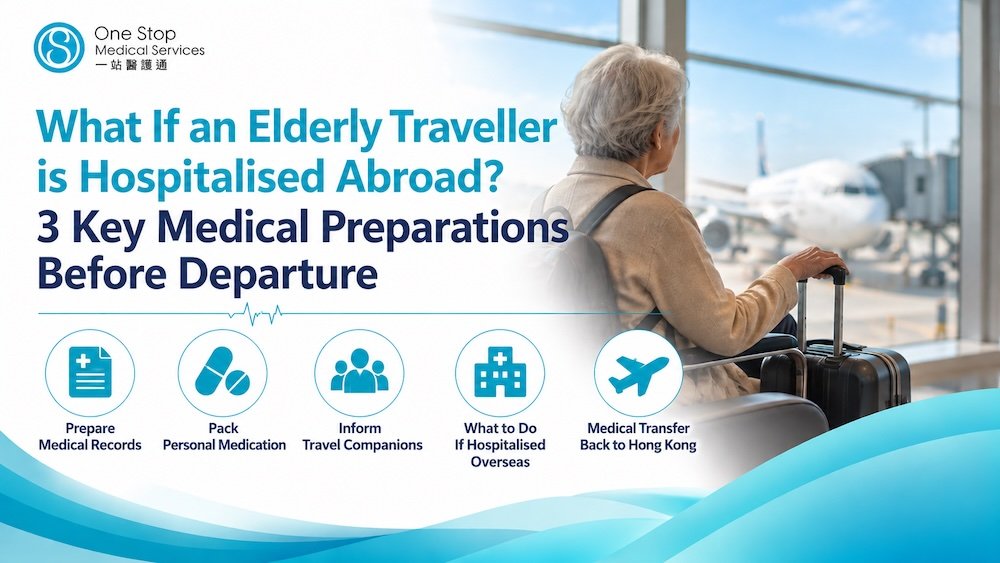
A holiday should be something to look forward to. But when an older traveller has heart disease, diabetes, long-term prescriptions or a history of major surgery, an unexpected collapse or injury abroad can leave companions unable to answer the treating team’s questions about medical history, medicines or allergies.
This does not mean that emergency treatment cannot begin without medical records. Clinicians can act on the patient’s current condition and test results. However, readily available information can help them understand important background details and plan subsequent assessment and care.
An illustrative travel scenario: when companions do not know the medical history
Mr A has a cardiovascular condition and takes a long-term anticoagulant, often called a blood thinner. Years earlier, he underwent hip surgery following a fall and also had metal fixation placed in his lower leg. After retirement, he regularly travelled to mainland China with friends.
Imagine that he falls and loses consciousness while visiting Shangri-La. His companions arrange urgent hospital care, but cannot explain his chronic conditions, previous operations, regular medicines or known drug allergies. Alongside emergency treatment, the local team must work quickly to establish those details through tests and contact with his family.
The scenario highlights how complex health problems can arise during travel. It does not establish that missing medical records cause acute kidney failure, gastrointestinal bleedingor other complications. Any such diagnosis and its cause require clinical assessment.
Preparation 1: Ask your doctor for a concise medical summary
People with chronic conditions, long-term prescriptions or major surgical histories should consider a pre-travel consultation. Ask the treating doctor for a brief medical summary and, if helpful, an English version or a translation into a language commonly used at the destination. Hong Kong’s Travel Health Service advises travellers with chronic illnesses to arrange a consultation at least six weeks before departure.
- Current diagnoses and important history, including cardiovascular disease, diabetes, kidney conditions and major operations.
- Current medications: generic names, doses, timing and purpose, with particular attention to anticoagulants and other clinically important medicines.
- Known medication or food allergies, previous serious adverse reactions, and any required medical devices.
- The treating clinician’s details, emergency contacts and relevant recent test results where appropriate.
Keep an offline electronic copy and a paper copy in an accessible place. Share sensitive medical information only with people who need it.
Preparation 2: Pack your own medicines and a basic travel health kit
Take enough prescribed medication for the planned trip, plus a reasonable extra supply for delays as advised by your clinician. Keep medicines in their original labelled containers, with prescription details available, and carry essential supplies in hand luggage rather than relying on checked baggage.
A personal travel health kit may include simple wound-care items and medicines recommended by a doctor or pharmacist for the destination and the individual traveller. Do not add prescription medicines “just in case”, use someone else’s medicines, or stop or change an anticoagulant dose on your own. Check whether any medication is restricted at the destination before leaving.
Preparation 3: Tell one trusted companion where the essentials are
Travellers need not share their complete health history with everyone. It is useful, however, for one trusted companion to know where the medical summary is stored, whom to call in an emergency, and whether there are serious allergies or other urgent precautions. For remote destinations, check local medical access, emergency contacts and whether travel insurance includes overseas treatment and emergency medical transfer.
What should the family do if hospitalisation occurs abroad?
- Prioritise urgent treatment at the nearest appropriate facility, while providing the medical summary, medicine list and allergy details as soon as possible.
- Stay in contact with the treating team and obtain an update on diagnosis, tests, treatment and clinical stability.
- If returning to Hong Kong or moving to another hospital is being considered, obtain a medical assessment of fitness for transfer before choosing transport.
- Clarify insurance benefits, required documentation and the receiving facility’s handover arrangements.
Medical escort is a possible next step—not a substitute for emergency care
Following treatment overseas, some patients may wish to continue their care or recovery in Hong Kong. The suitability of a cross-border ambulance, an escorted commercial flight or another medical-transfer arrangement depends on clinical status, the medical assessment, transport and airline requirements, and acceptance by the receiving facility.
ONE STOP MEDICAL SERVICES encourages older travellers and people with chronic illnesses to make medical records, personal medicines and allergy information part of their travel essentials. Families considering a medical transfer after an overseas admission may contact us to discuss potential escort and handover arrangements.
One Stop Medical Services provides professional point-to-point, seamless medical escort services. We can assist you or your family with complicated procedures and ensure that the patient receives appropriate medical monitoring and care throughout the journey back to Hong Kong.
For a free enquiry, please call or WhatsApp +852 9788 9115.