
ONE STOP MEDICAL SERVICES · AIR MEDICAL ESCORT
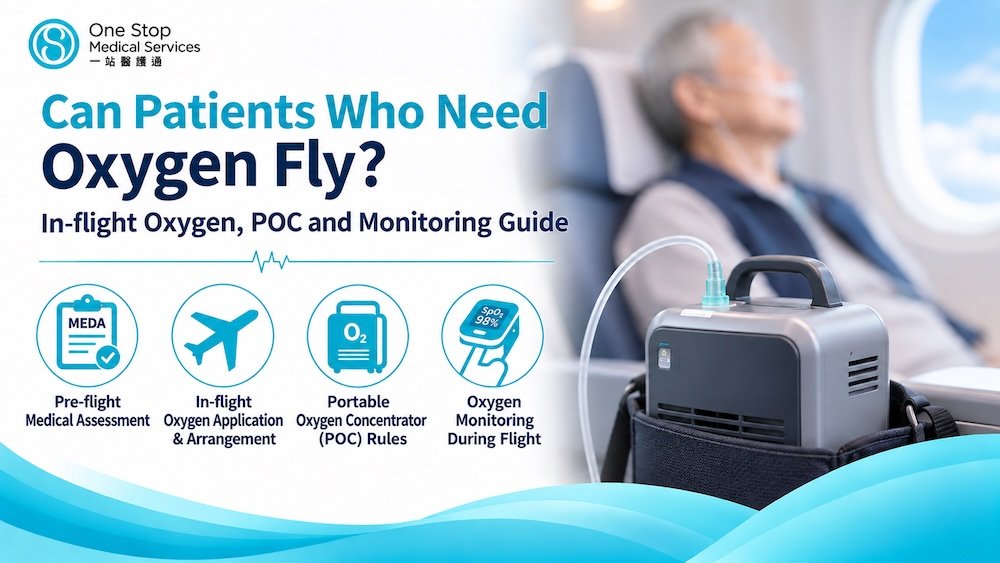
Can a Patient Who Needs Oxygen Fly? In-flight Oxygen, Concentrators and Monitoring
“My family member uses oxygen every day. Can they still fly?” is a common question for medical escort enquiries and one that needs a careful answer.
The need for oxygen does not automatically rule out commercial air travel. Fitness to fly, however, must be assessed in light of the patient's heart and lung condition, the oxygen delivery method and flow required, the airline's equipment arrangements and the risks associated with the journey.
1. Why does oxygen saturation need special attention during a flight?
Although commercial aircraft are pressurised, the cabin pressure during cruise usually corresponds to an altitude above sea level. The US Centers for Disease Control and Prevention notes that cabin pressure altitude is typically equivalent to around 6,000–8,000 feet, meaning the available partial pressure of oxygen is lower than on the ground.
For most healthy travellers, this generally causes no obvious problem. For someone with lung or cardiovascular disease, low baseline oxygen saturation or an existing requirement for oxygen, however, it may increase the risk of falling oxygen levels or worsening symptoms.
A single oxygen saturation reading before departure may therefore be insufficient to assess a whole flight. When needed, the treating doctor should arrange an appropriate pre-flight assessment.
2. In-flight medical oxygen usually has to be requested in advance
Passengers should not assume they can bring a household oxygen cylinder on board for personal use. Airline restrictions on cylinders and other oxygen equipment relate to cabin safety and dangerous-goods rules.
For example, Cathay Pacific does not allow passengers to bring and use their own oxygen cylinders in the cabin. Medical oxygen supplied by the airline may be requested in advance, subject to availability. The airline's stated settings are continuous flows of 2 or 4 litres per minute, with a maximum of 4 litres per minute, and it recommends applying at least 72 hours in advance.
These provisions are specific to Cathay Pacific. They should not be treated as oxygen flow limits or services offered by every airline, nor as an indication of the flow any particular patient needs.
3. Can a portable oxygen concentrator be used on board?
Some airlines permit compliant Portable Oxygen Concentrators (POCs), but not every model is accepted. Cathay Pacific, for instance, has requirements relating to advance notification, acceptable devices, medical declarations and sufficient compliant batteries.
Portable oxygen concentrators and oxygen cylinders may deliver oxygen differently, and concentrators may operate in continuous-flow or pulse-dose modes. Healthcare professionals must therefore judge whether a device meets the patient's needs in the flight environment. The number displayed on a machine should not be compared without considering the actual mode of delivery.
4. Monitoring and nursing care continue after take-off
For a medically escorted patient, accompanying clinicians observe breathing, oxygen saturation and other vital signs according to the individual care plan. They also watch for fatigue, respiratory distress, altered consciousness or other changes.
Necessary care continues in flight as circumstances allow. Where in-flight oxygen has been approved, its use follows medical instructions, the actual equipment available and airline safety requirements.
Business class is not a hospital ward. Space, electrical power, equipment and emergency treatment capability are limited. If the patient's oxygen or intensive care needs exceed what a commercial aircraft can support, a different transport arrangement may be required.
5. Oxygen provision must connect across ground and air transfers
Even with an approved in-flight oxygen arrangement, the patient's needs at the departure airport, during any waiting period, after landing and en route to the receiving medical facility must also be considered. Oxygen supplied by the airline may not cover the ground portion of the journey.
The escort plan should identify the equipment needed throughout, who provides it, when handovers occur and how delays will be managed.
What should families confirm first?
Families can prepare the treating doctor's advice on oxygen needs, the model of equipment currently used, relevant medical reports and the proposed flight route. These can then be discussed with the airline and medical escort team. Oxygen flow should never be adjusted independently, and general travel advice should not replace professional medical judgement.
If a family member needs oxygen support or oxygen saturation monitoring during air travel, contact ONE STOP MEDICAL SERVICES to discuss the feasibility and preparation required for a medical escort.
One Stop Medical Services provides professional point-to-point, seamless medical escort services. We can assist you or your family with complicated procedures and ensure that the patient receives appropriate medical monitoring and care throughout the journey back to Hong Kong.
For a free enquiry, please call or WhatsApp +852 9788 9115.