
For an ordinary passenger, travelling from Hong Kong to Mainland China by high-speed rail may simply involve purchasing a ticket, clearing immigration, waiting for the train and boarding.
For a patient who must remain lying down, requires continuous nursing care, or depends on medical equipment, however, the journey is very different.
High-speed trains have limited boarding and stopping times. A bedbound patient cannot simply board and leave the train in the same way as an ordinary passenger. From the hospital bed in Hong Kong to the receiving hospital bed in Mainland China, every transfer point requires advance planning and coordination.
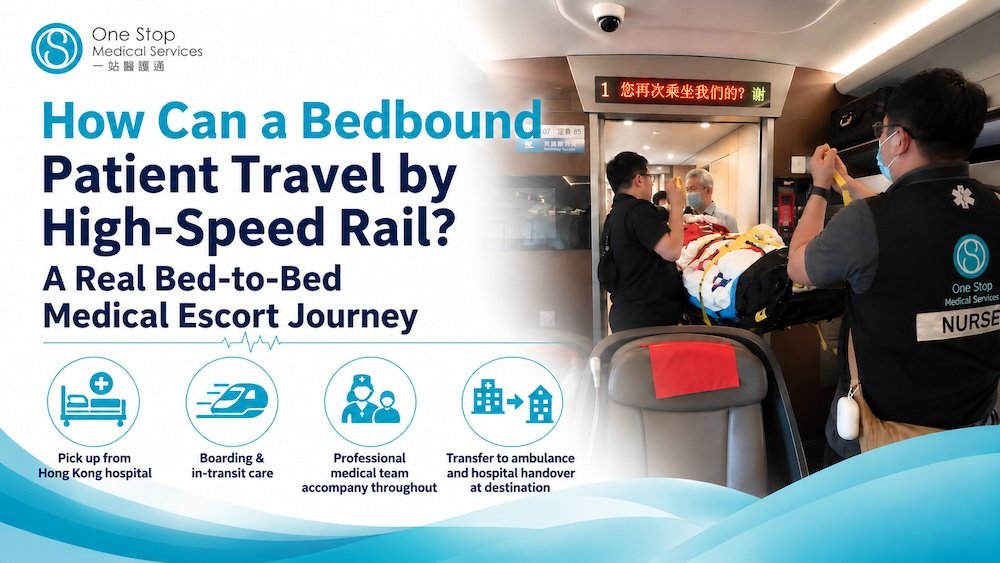
During a recent high-speed rail medical escort case, the medical escort team collected the patient from a hospital in Hong Kong, travelled by high-speed rail to Mainland China, connected with a local ambulance after arrival, and accompanied the patient all the way to the receiving hospital — completing a genuine bed-to-bed transfer.
Preparation Starts Long Before the Train Departs
A high-speed rail medical transfer does not begin on the morning of departure.
In this case, arrangements for train tickets and the journey were made in advance. The team also needed to understand the patient’s condition, nursing requirements and the medical equipment that might be required during transport.
Some long-distance high-speed rail services depart early in the morning. This means the medical escort team may need to arrive at the hospital before sunrise to collect the patient.
For an ordinary traveller, the journey begins when the train departs. For a medical escort team, the work may have started several hours earlier.
One of the Biggest Challenges: The Train Cannot Wait
One of the key considerations when transporting a bedbound patient by high-speed rail is the limited boarding window.
The patient’s transfer cannot simply be organised after the train arrives.
In this case, the team first prepared the patient in the waiting area. Approximately 15 minutes before the train arrived, relevant personnel were already preparing at the platform.
The patient then had to be transferred with the assistance of the medical and support teams and boarded within the available time.
The stretcher position, staff responsibilities, medical equipment and the patient’s physical condition all had to be considered in advance.
This is why professional medical escort is not simply a matter of having someone accompany a patient on a train. It is a coordinated medical transport operation that requires careful preparation.
Medical Care Does Not Stop Once the Patient Boards
Families often ask:
Can nursing care continue while the train is moving?
In this case, the patient’s stretcher was positioned according to the actual train arrangement.
Throughout the journey, medical personnel remained with the patient and continued the necessary care according to the patient’s condition. This could include monitoring vital signs, administering intravenous therapy, repositioning the patient and assisting with feeding.
In other words, care does not stop when the patient leaves the hospital, nor does it have to be suspended for several hours simply because the patient is travelling by train.
One of the key purposes of professional medical escort is to maintain continuity of care as far as reasonably possible throughout the transfer.
Every patient is different, however. The exact nursing procedures, medical equipment and staffing required must be assessed according to the individual patient’s condition.
About 30 Minutes Before Arrival, Preparation Begins Again
Boarding is only one part of the journey. Getting the patient off the train also requires careful coordination.
In this case, the medical team was notified approximately 30 minutes before arrival so that preparations could begin.
Receiving personnel were also arranged in advance at the platform.
The reason is straightforward: high-speed trains have limited station dwell times.
A bedbound patient cannot wait until the train has stopped before staff begin organising equipment and transfer arrangements.
For this particular case, the relevant disembarkation and transfer procedures needed to be completed within approximately five to ten minutes.
What may be only a short walk for an ordinary passenger becomes a carefully timed operation when a stretcher, medical equipment and several members of staff are involved.
Leaving the Train Does Not Mean the Escort Is Finished
Another detail families may not realise is that there can still be a transfer distance between the train and the connecting ambulance.
Under the arrangements for this particular case, the ambulance could not drive directly beside the train platform to collect the patient.
The patient therefore had to be manually transferred onto a stretcher trolley and escorted out of the station before connecting with the pre-arranged ambulance.
The medical escort team did not end its responsibility at the railway station.
The team continued accompanying the patient by ambulance to the receiving hospital, where a formal handover was completed with the local medical team.
Only then was the medical transfer considered complete.
From one hospital bed in Hong Kong to another hospital bed in Mainland China, this is what is meant by:
Bed-to-bed medical escort.
Which Patients May Be Considered for High-Speed Rail Medical Escort?
High-speed rail is not suitable for every patient.
Based on practical medical escort experience, some patients who need to remain lying down, remain under observation after surgery, or require continuous monitoring during transport may be considered for high-speed rail transfer if their condition is sufficiently stable and the medical team determines that the journey is appropriate.
Some patients requiring ventilatory support may also be considered where their oxygen requirements, equipment needs and overall condition can be safely accommodated.
Patients with higher oxygen requirements, however, require particularly careful assessment.
High-speed rail transport involves practical limitations concerning portable medical equipment and oxygen delivery. If the required oxygen supply cannot be safely maintained using suitable equipment for the rail environment, another form of medical transport may need to be considered.
Patients with communicable diseases also require separate assessment according to their medical condition, public health requirements and transportation regulations.
The key question is therefore not simply:
“Can this patient travel by high-speed rail?”
It is:
“Given this patient’s present condition, is high-speed rail one of the safe and appropriate medical transport options?”
Why Might High-Speed Rail Be Considered?
In appropriate cases, high-speed rail offers several practical advantages.
Mainland China’s high-speed rail network covers a wide range of destinations and offers multiple daily services. For some long-distance routes, rail travel may reduce the amount of time a patient would otherwise spend travelling entirely by road ambulance.
Train travel is also relatively stable, which can assist medical personnel in continuing patient observation and necessary nursing care during the journey.
Compared with air medical transport, high-speed rail does not involve the cabin pressure changes associated with flight.
For some patients who have undergone brain surgery or who have certain chest or pulmonary conditions requiring additional consideration before flying, the medical team may compare high-speed rail, road ambulance and air medical transport before recommending an appropriate option.
High-speed rail should therefore not be viewed simply as a replacement for an ambulance or aircraft. It is one possible medical transport option that may be considered according to the patient’s condition, destination, travel distance and equipment requirements.
The Most Difficult Part Is Not Buying the Ticket
Collecting the patient from a Hong Kong hospital, travelling to the railway station, preparing for boarding, maintaining care during the journey, preparing before arrival, completing a time-sensitive transfer from the train, connecting with an ambulance and finally reaching the receiving hospital…
Each individual step may sound straightforward.
But when a patient must remain lying down, requires medical monitoring or depends on medical equipment, every handover point needs to be planned in advance.
That is why high-speed rail medical escort is about far more than purchasing a train ticket.
It is about maintaining appropriate care and coordination from the moment the patient leaves one hospital bed until the patient reaches the next.
One Stop Medical Services provides professional point-to-point, seamless medical escort services. We can assist you or your family with complicated procedures and ensure that the patient receives appropriate medical monitoring and care throughout the journey back to Hong Kong.
For a free enquiry, please call or WhatsApp +852 9788 9115.