
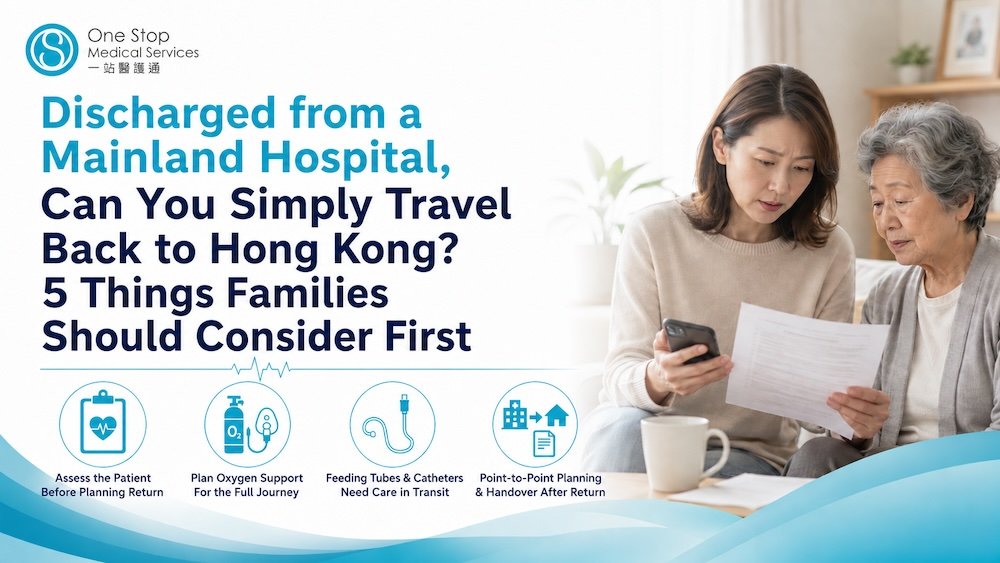
A family member suddenly becomes unwell while travelling or visiting relatives in Shenzhen, Guangzhou or another city in Mainland China and needs to be admitted to hospital. After several days of treatment, the doctor says that the patient’s condition has stabilised and discharge may be considered.
For many Hong Kong families, the first thought is: “If the hospital says the patient can be discharged, can’t we simply arrange a car and bring them straight back to Hong Kong?”
In practice, it may not be that simple.
Some patients no longer require acute inpatient treatment but remain physically weak. Some still require oxygen. Others may still have a nasogastric feeding tube, urinary catheter or other medical device in place. A patient recovering from pneumonia, stroke, surgery or a serious infection may also find prolonged sitting, turning or even transferring from a hospital bed to a wheelchair difficult.
In this situation, “being fit for discharge” and “being suitable for a family-arranged cross-border journey” are two different questions.
Discharge does not mean there are no medical needs during the journey
A hospital’s decision on discharge mainly considers the patient’s current condition and whether inpatient treatment is still required.
Travelling from Mainland China back to Hong Kong, however, is a separate journey with its own practical and clinical considerations.
The process may involve transferring the patient from a hospital bed to a stretcher or wheelchair, travelling by vehicle, clearing the border, waiting at different stages, and then continuing from the boundary crossing to a home, residential care home or hospital in Hong Kong.
For a healthy traveller, this may simply be a car journey. For someone who has just completed hospital treatment, the entire process can last several hours.
Before transport is arranged, the family should therefore consider the patient’s actual condition, the level of care and monitoring required, any equipment that may be needed, and whether a trained medical escort is appropriate. Patient transfer guidance generally emphasises that transport arrangements should be matched to the patient’s clinical needs and level of risk.
1. Is the patient truly stable, or simply more stable than when they were admitted?
Families should first clarify the patient’s current condition with the treating doctor. Useful questions include: What was the original reason for admission? How much has the condition improved? Are the vital signs stable? Is the patient still experiencing shortness of breath, dizziness, confusion or chest discomfort? Are there specific symptoms that the family should watch for during transport?
For example, an older patient admitted with pneumonia may have improved sufficiently to leave hospital but may still become breathless easily, have lower oxygen saturation or have significantly reduced mobility.
Even if discharge criteria are met, such a patient may still require more support during a cross-border journey than an ordinary passenger.
Instead of asking only, “Can the patient be discharged?”, families should also ask: “Given the patient’s current condition, are they suitable for a longer road journey and cross-border travel back to Hong Kong?”
2. If oxygen is still required, how will it be provided throughout the journey?
This is one of the issues that can easily be overlooked.
A patient may have been receiving oxygen continuously in hospital, while the family assumes that a two- or three-hour journey back to Hong Kong will be manageable.
However, the relevant time is not simply the driving time shown on a map. It also includes the transfer out of the ward, waiting time, border procedures, traffic conditions and the onward journey from the boundary crossing to the final destination in Hong Kong.
If the patient still requires oxygen during transport, the required method of oxygen delivery, flow rate or other instructions should be confirmed with healthcare professionals before departure. The supply should be sufficient for the full journey, including reasonable allowance for possible delays. Medical transfer guidance similarly requires the anticipated oxygen requirement to be assessed before departure and sufficient supply to be available for the transfer.
In other words, simply bringing an oxygen cylinder does not by itself mean that the issue has been fully addressed.
3. A feeding tube or urinary catheter does not automatically prevent travel, but the care requirements must be understood
Older patients and people with long-term illnesses may still have a nasogastric feeding tube, urinary catheter or other medical device in place when they leave hospital.
Families can sometimes react in one of two extremes: either assuming that the patient cannot be moved at all, or assuming that no special attention is required simply because discharge has been approved.
Neither assumption is necessarily correct.
The important step is to understand why each device is in place, whether any specific care is required during transport, and how to avoid pulling, displacement or unnecessary discomfort when the patient is turned, transferred, seated or moved on and off a stretcher.
Families should also know what to do if a problem with the device is noticed during the journey, rather than trying to work it out for the first time at the border.
Tubes and medical devices should not be removed or altered by family members without instructions from healthcare professionals.
4. Can the patient tolerate the entire journey from the hospital bed to the final destination in Hong Kong?
When arranging transport, families often focus on one question: “Can the vehicle take a wheelchair?”
The more important consideration is the entire point-to-point journey.
Can the patient sit up independently? Can they transfer from a bed to a wheelchair? How long can they maintain a seated position? Do they have pressure sores, a fracture, a surgical wound or severe pain? Do they need to remain lying down? How many people are required to assist with transfers? Are there stairs at the destination in Hong Kong? If the destination is a hospital, how will the receiving and handover process be arranged?
These may appear to be practical rather than medical questions, but they directly affect the safety and comfort of the transfer.
For an older person, a long-term bedbound patient, someone who has recently undergone surgery or a patient with a neurological condition, even a simple bed-to-chair transfer may require more assistance than one family member can safely provide.
5. Do not plan only how to “get back to Hong Kong” — plan what happens after arrival
One common problem in cross-border medical transport is that families focus almost entirely on how to clear the border.
But crossing the border is not the end of the journey.
Where will the patient go afterwards? Home to recover? Back to a residential care home? To a private hospital? Or to another healthcare facility for continued treatment?
If ongoing medical follow-up is needed, it is useful to organise the Mainland hospital’s discharge summary, investigation reports, imaging records, current medication list and other relevant medical documents before leaving.
These records can help healthcare professionals in Hong Kong understand what treatment has already been provided and reduce the difficulty of asking family members to reconstruct the entire medical history from memory.
What is the difference between travelling with family and using a medical escort?
If the patient is alert, mobile, clinically well and has no special medical needs, travelling with family using ordinary transport may be sufficient.
However, if the patient has only recently completed hospital treatment, remains weak, has reduced mobility, still requires oxygen or medical devices, or needs clinical monitoring and professional assistance during the journey, the family should reassess whether an ordinary private car or cross-border vehicle is appropriate.
Professional medical escort is not simply about providing a vehicle.
The key is to understand the patient’s needs before departure, arrange an appropriate form of transport, equipment and escort personnel, and coordinate the full transfer from the hospital bed in Mainland China to the hospital, residential care home or residence in Hong Kong.
The key question is not simply whether the hospital allows discharge
When a family member is hospitalised away from home, it is natural to want to bring them back to Hong Kong as soon as their condition improves.
But the more urgent the situation feels, the more important it is to ask one question first: Is the patient physically able to complete the journey safely in their current condition?
Hospital discharge marks an important stage of treatment. Safely returning from Mainland China to Hong Kong is the next stage and requires separate planning.
Before choosing a private car, cross-border vehicle or medical escort, families should first understand the patient’s condition, mobility, oxygen requirements and other care needs, and then select a transport arrangement appropriate to those needs.
One Stop Medical Services provides professional point-to-point seamless medical escort services. We can assist you or your family with complex arrangements and help ensure that appropriate medical monitoring and care are provided throughout the journey back to Hong Kong.
For enquiries, please call or WhatsApp +852 9788 9115 for a free consultation.